Jaspreet Dhugga – Mortgage Broker Brampton, GTA And Ontario



Should I Switch Lenders at Renewal in Toronto or Stay?
- Home
- Should I Switch Lenders at Renewal in Toronto or Stay?

The easiest renewal isn’t always the best value. If you’re asking whether you should switch lenders at renewal in Toronto, you’re not required to stay with your current lender. Compare the full cost and terms of switching with the renewal offer before deciding.
It’s understandable to lean toward staying: renewing with your current lender is usually simpler, while switching involves a new application and mortgage transfer. A lower rate may make switching worth considering, depending on the costs, paperwork and time involved. This article explains how to weigh both options, what switching can involve, and when staying may make more sense. You’ll have a clearer basis for deciding before your mortgage term ends.
Key Takeaways
- Compare the total cost over the mortgage term, not just the rates. A lower rate matters most when its savings outweigh switching expenses.
- Factor in the new application, mortgage transfer and title registration when weighing the convenience of staying against switching.
- Start comparing renewal options well before your term ends to leave time for paperwork and processing.
- Staying may make sense when your current lender offers suitable terms and switching would add cost or complexity without enough benefit.
Should You Stay with Your Lender or Switch at Renewal Time?
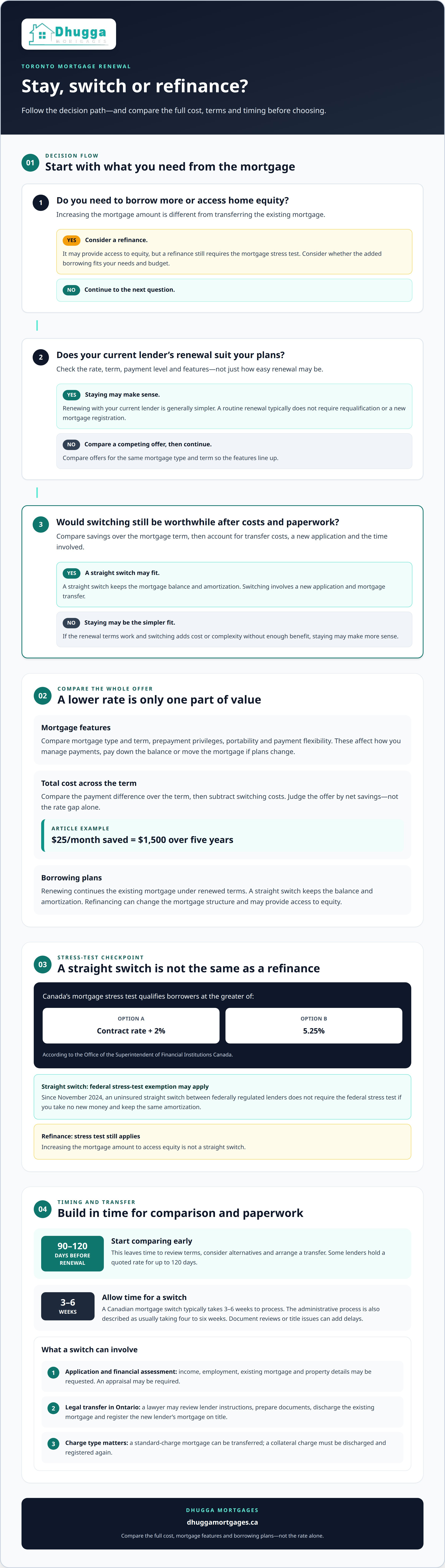
If you’re asking whether you should switch lenders at renewal in Toronto, compare the offer and features with your plans. Staying is often simpler; switching may suit you if the terms better match your budget or borrowing needs.
Mortgage Type, Term, and Prepayment Privileges
Review whether your mortgage type and term still fit your finances. Compare prepayment privileges, portability and payment flexibility, not just the interest rate. These features affect how you manage payments, pay down the balance or move the mortgage if your plans change. A mortgage broker can compare the contract details so your decision reflects how you expect to use the mortgage.
Stress-Test Rules for Lender Switches
According to the Office of the Superintendent of Financial Institutions Canada, Canada’s mortgage stress test qualifies borrowers at the greater of the contract rate plus 2% or 5.25%. Since November 2024, an uninsured straight mortgage switch between federally regulated lenders doesn’t require the federal stress test if you take no new money and keep the same amortization. For a homeowner deciding whether to switch lenders at renewal in Toronto, that distinction matters if payments are rising.
Increasing the mortgage amount to access equity is different from a straight switch. A refinance still requires the stress test, so consider whether additional borrowing fits your needs and budget. Staying may be practical if you don’t need new features or funds and the renewal terms work for you.
| Option | Features to compare | Borrowing needs |
|---|---|---|
| Renew with current lender | Rate, term, payments and prepayment privileges | Existing mortgage continues under renewed terms |
| Switch lender | New contract features and portability | Straight switch keeps the balance and amortization |
| Refinance | New payment and mortgage structure | May provide access to equity |
Choose the option that fits your mortgage features, comfortable payment level and borrowing plans, not the rate alone.
Comparing a renewal with the current lender against switching
If you’re deciding whether you should switch lenders at renewal in Toronto, compare the full offer, not just its advertised rate. A competing mortgage should fit your budget and plans after you account for transfer costs and paperwork.
Renewal Offers and Market Rates
Your current lender’s renewal offer is the starting point, not the only option. Compare it with offers for the same mortgage type and term so the features line up. Toronto homeowners are advised to start comparing 90-120 days before renewal. A mortgage broker can help organize the comparison and identify differences in terms that make two seemingly competitive rates less alike.
Interest Rates and Total Costs
Compare the payment difference across the term, then subtract the costs of switching. A $25 monthly payment saving totals $1,500 over five years. Use the net savings, rather than the rate gap alone, to judge the value.
When to Compare Offers
Begin the comparison 90-120 days before your renewal date. That gives time to review the existing lender’s terms, consider alternatives and arrange an administrative transfer. Some lenders hold a quoted rate for up to 120 days. Early action also helps if your needs have changed and you’re considering a refinance rather than renewing or transferring the existing mortgage.
Risks of Switching at Renewal
Switching can involve transfer costs, a new application and delays. A Canadian mortgage switch typically takes 3-6 weeks to process. Document or title issues can put pressure on the timeline near maturity. If you’re still asking whether you should switch lenders at renewal in Toronto, weigh those risks against the potential savings and the renewal terms that suit your situation. A mortgage broker can help map out the comparison and timing; discuss your renewal options before choosing.
The process and documentation for switching lenders
Switching lenders involves a new mortgage application, financial assessment and transfer of the mortgage to the new lender. A mortgage professional can coordinate the application and transfer timeline, while you provide the information needed to assess your eligibility.
The application typically asks for details about your income, employment, existing mortgage and property. The new lender uses this information to assess your application and set the mortgage terms. Complete, accurate documents help keep the review moving. If the lender requires an appraisal, the property may also need to be assessed before approval.
After approval, the legal transfer is arranged. In Ontario, a lawyer may review the new lender’s instructions, prepare documents, discharge the existing mortgage and register the new lender’s mortgage on title. The lender will generally want its mortgage secured against the property before advancing funds. A standard-charge mortgage can be transferred, while a collateral charge must be discharged and registered again.
Timing matters. The administrative process usually takes four to six weeks, and document reviews or title issues can add delays. A mortgage professional can coordinate the application, lender requirements and lawyer’s work around the maturity date. Starting early leaves more time to resolve missing information and assess potential savings without rushing your decision.
Renewing with your current lender is simpler. The lender sends renewal terms, and you decide whether to accept or negotiate. A routine renewal typically doesn’t require requalification or a new mortgage registration. Switching lenders generally involves a new application and financial assessment. Refinancing is different again: borrowing more or changing the mortgage can affect qualification and the paperwork involved.
- For a switch: provide the financial and income information requested for the new application.
- For a renewal: review the current lender’s terms and confirm the renewal decision.
- For a transfer: allow the mortgage professional and lawyer to coordinate discharge and registration.
When staying with the current lender may make sense
Staying can suit homeowners whose mortgage needs are unchanged and whose current lender offers acceptable renewal terms. A routine renewal typically avoids the new application and legal transfer involved in switching. If simplicity and continuity matter more than changing mortgage features, compare the renewal offer carefully before signing.
Staying can also make sense when a new lender’s rate advantage is small after transfer costs, or when meeting new qualification requirements may be difficult. Your current lender typically doesn’t require requalification at renewal. Switching involves a new application and financial assessment, so changes in income or credit circumstances can affect the options available.
Staying has drawbacks. Your existing lender’s first offer may not be its most competitive, and accepting it without comparing terms could mean missing a better fit. Review the interest rate, term, payment schedule, prepayment privileges and portability. A lower rate elsewhere isn’t automatically better if the new mortgage lacks a feature you rely on.
Consider your plans, too. If you expect to move, check whether portability suits your situation. If you need to access equity or change your amortization, a basic renewal may not meet your goal; those changes involve a different borrowing assessment. An appraisal may also be required by a new lender, adding a step compared with a straightforward renewal.
Keep the renewal date visible. The Financial Consumer Agency of Canada says a renewal offer should arrive at least 21 days before the mortgage term ends. That deadline is not a reason to wait: compare the offer and alternatives early, then leave time for paperwork and signing. Staying makes sense when the terms suit your plans and switching’s added work has no clear benefit.
For a focused review of your renewal terms and priorities, discuss your mortgage options.
Dhugga Mortgages
Dhugga Mortgages can help you compare renewing with your current lender against switching. A mortgage professional can review the terms, payments and features in light of your plans, then help clarify which route fits your situation. If you’re considering accessing home equity or changing your borrowing, Mortgage Refinancing may also be relevant. The goal is a clear comparison, including how paperwork and qualification affect your decision, so you can move forward with a better understanding of your options.
Contact Dhugga Mortgages to discuss your renewal options.
Make your renewal decision with clarity
Connect your renewal decision to your plans for your home and finances. If you’re weighing whether to switch lenders at renewal in Toronto, focus on the option that supports those plans, not simply the easiest paperwork or lowest rate. A clear comparison can help you move forward with purpose.
Dhugga Mortgages can help you assess mortgage options around renewal. If your needs go beyond renewal, its services also include First-Time Home Buyer Mortgages, Mortgage Refinancing and Debt Consolidation. Start with what you want your mortgage to do next.
Start a conversation with Dhugga Mortgages about your renewal. Take the next step with a clearer view of your options.
Frequently Asked Questions
Does switching lenders trigger the stress test?
Not for every switch. Since November 2024, an uninsured straight mortgage switch between federally regulated lenders doesn’t require the federal stress test if you take no new money and keep the same amortization. Borrowing additional funds, changing amortization or refinancing can change the assessment. A mortgage professional can distinguish a straight transfer from a new borrowing request before the application goes forward.
Is switching cheaper than breaking my mortgage mid-term?
Switching at renewal can avoid breaking your mortgage before its term ends, which could otherwise trigger a contract-based prepayment charge. However, switching at renewal can still involve expenses: transfer costs affect the comparison. Compare the total cost of moving lenders at maturity with the cost of ending your current contract early, including any charge your existing lender calculates.
Does it cost money to change lenders?
It can. The amount you pay depends on which transfer expenses apply and which costs the new lender covers. A straightforward transfer may have standard legal and administrative costs covered, but discharge, appraisal or title requirements can change what you pay. Request a written breakdown of covered and uncovered expenses before deciding, then compare the net cost with the expected mortgage savings.
How does switching at renewal work with a mortgage professional, step by step?
A mortgage professional reviews your renewal date, goals and current mortgage details, then compares suitable offers and organizes the application using your financial and property documents. After the new lender approves the mortgage, the professional coordinates the transfer with the lawyer and lender. The lawyer handles the required discharge and registration, and the new lender funds the mortgage to replace the existing loan.
How early should I start?
Start comparing options 90-120 days before your renewal date. That window gives a Toronto homeowner time to review offers and prepare documents while there’s room to address title questions or lender requirements. If you leave the comparison until close to maturity, administrative delays can narrow your choices and make the transfer harder to complete without pressure.
Shhh, is that the sound of your renewal payments rising?
They could rise if your renewal terms result in a higher payment. The amount depends on factors such as the new interest rate, outstanding mortgage balance and remaining amortization. For example, two homeowners renewing at the same rate may still have different payments if their balances or repayment timelines differ. Compare the proposed payment with your budget before accepting the renewal terms.