Jaspreet Dhugga – Mortgage Broker Brampton, GTA And Ontario



Early Mortgage Renewal in Mississauga: Compare Your Options
- Home
- Early Mortgage Renewal in Mississauga: Compare Your Options

An early mortgage renewal in Mississauga may be available before your current term ends, but renewing early doesn’t automatically mean you’ll get the best rate. Most Canadian lenders allow renewal 90 to 180 days before maturity. The right timing and rate depend on the lender, your mortgage details and the options available to you.
It’s reasonable to wonder whether an early renewal rate will match a rate for buying or refinancing in Mississauga. These are different mortgage situations, so rates and conditions can vary. A renewal may let you secure new terms without changing your mortgage amount, while refinancing can involve different qualification requirements and may let you access home equity.
This guide explains how rates compare, when lenders may allow an early renewal and what options you can consider, including changing your term or exploring refinancing. You’ll also learn what can affect eligibility, when switching before maturity may trigger a penalty, and how to weigh the options against your plans. Review the key details, then decide which route best fits your mortgage and budget.
Key Takeaways
- Compare renewal rates with purchase and refinancing rates, and consider how changing market conditions may affect your timing.
- Explore the available renewal choices and learn when it may make sense to act before your term ends.
- Weigh the trade-offs between renewing, switching lenders and refinancing, including potential penalties and access to home equity.
- Understand what can affect early-renewal eligibility and when refinancing or debt consolidation may better fit your plans.
Do mortgage rates vary based on whether I’m buying a home, renewing, or refinancing?
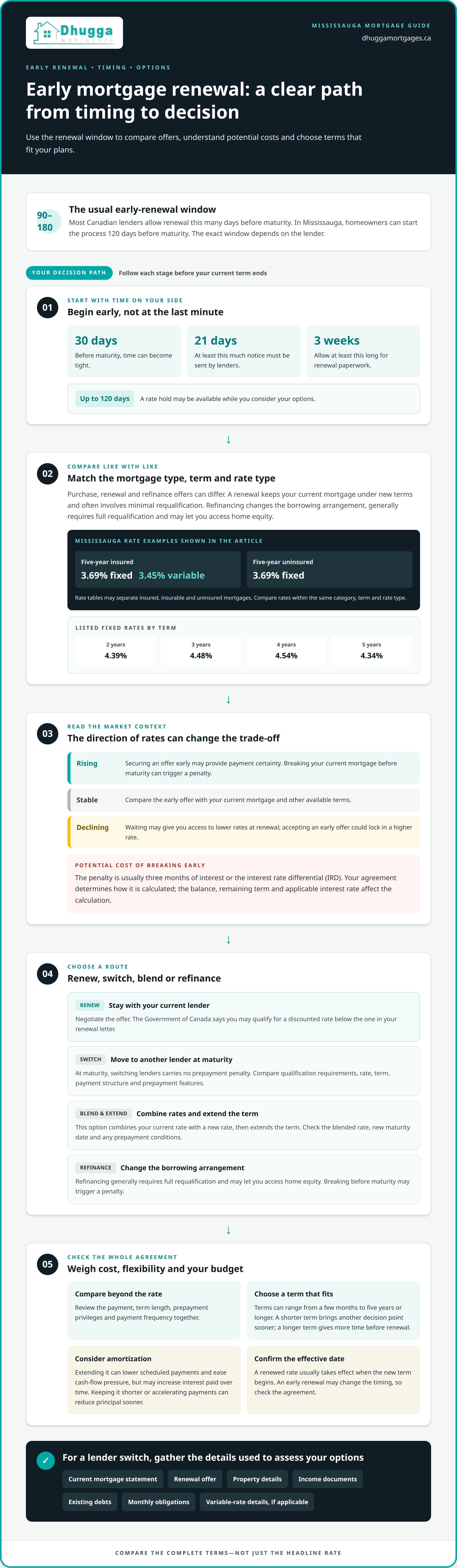
Yes. A purchase, renewal and refinance are different lending situations, so mortgage rates and available terms can vary. A renewal keeps your current mortgage in place under new terms. Refinancing changes the borrowing arrangement and generally requires full requalification, while renewal often involves minimal requalification. Compare offers for the same mortgage term and rate type, rather than focusing only on the headline interest rate.
Market direction can affect whether an early renewal makes sense. If rates are rising, securing a lender’s offer early may provide payment certainty, but breaking your current mortgage before maturity can trigger a penalty, usually three months of interest or the interest rate differential. If rates are stable, compare the offer with your current mortgage and other available terms. If rates are declining, waiting may give you access to lower rates at renewal, while accepting an early offer could lock in a higher rate.
The Bank of Canada’s policy rate was 2.50% after its October 28, 2026 increase. Variable mortgage rates can move with lender prime rates, while fixed mortgage rates are influenced by bond yields and lender expectations.
For an insured mortgage, options include renewing with the current lender, negotiating new terms or switching lenders. Refinancing is a different option that changes the borrowing arrangement. Rate tables may separate insured, insurable and uninsured mortgages, so compare rates within the same category. Mississauga’s displayed five-year insured rates were 3.69% fixed and 3.45% variable; the uninsured five-year fixed rate was 3.69%, updated November 23, 2026.
Mississauga’s listed fixed rates also vary by mortgage term: 4.39% for two years, 4.48% for three years, 4.54% for four years and 4.34% for five years. A renewed mortgage rate usually takes effect when the new term begins. An early renewal may change that timing, so the agreement’s effective date matters.
Mortgage renewal options and timing
Yes, you can negotiate a renewal rate with your lender, and a mortgage broker can help compare available terms. The Government of Canada says you may qualify for a discounted interest rate below the one in your renewal letter.
Mortgage Term Choices
At renewal, choose a mortgage term that fits your financial plans and tolerance for payment changes. Terms can range from a few months to five years or longer, with five years the most common in Mississauga. A shorter term gives you another decision point sooner, while a longer term gives you more time before your next renewal. Compare the rate, payment and flexibility together.
Negotiating a Renewal Rate
Negotiation means asking your lender to improve its offer, then comparing the revised rate with other available options. A broker can help present your renewal details and assess potential alternatives. Look beyond the interest rate: prepayment privileges, payment frequency and term length also affect whether the mortgage fits your finances. Make your decision based on the overall terms, not one number.
Start comparing a few months before renewal. Thirty days before maturity, time can become tight; lenders must send a renewal notice at least 21 days before the term ends. Allow at least three weeks for renewal paperwork. A rate hold may be available for up to 120 days, which can protect an offer while you consider your options.
A blend-and-extend option combines your current mortgage rate with a new rate, then extends the term. It may suit borrowers who want to change their terms before maturity without simply replacing the mortgage. Ask how the blended interest rate, new maturity date and any prepayment conditions affect the overall cost.
Amortization is another renewal decision. Extending it can lower scheduled payments and ease cash-flow pressure, but may increase interest paid over time. If your budget allows, keeping the amortization shorter or accelerating payments can help reduce principal sooner. For a tailored review, discuss your renewal options.
Early renewal periods at major banks and lenders
In Mississauga, homeowners can start the renewal process 120 days before mortgage maturity. Early renewal windows differ by lender, so a major bank’s offer may arrive on a different schedule than another lender’s. Starting early gives a mortgage professional time to compare the market, review your current mortgage and assess whether switching fits your budget.
Breaking a mortgage before maturity to refinance may trigger a prepayment penalty. In Canada, the penalty is usually three months of interest or the interest rate differential (IRD). Your mortgage agreement determines how the lender calculates it for a fixed or variable rate. The balance, remaining term and applicable interest rate affect the calculation. At maturity, switching lenders carries no prepayment penalty.
To assess a switch, a mortgage professional typically needs your current mortgage statement, renewal offer and property details. Income documents help establish your financial picture, while information about existing debts and monthly obligations helps assess affordability. For a variable-rate mortgage, the current rate and payment details also help compare a new lender’s terms with your existing arrangement.
At maturity, a mortgage professional can compare lender offers, review qualification requirements and coordinate the switch. Compare the mortgage rate, term, payment structure and any prepayment features, not just the initial payment. A refinance differs from a straight switch because it changes the borrowing arrangement and requires full requalification.
Include these costs when weighing a lower interest rate against the financial benefit over the new term. A mortgage professional can organize the application and transfer details, then help assess whether the rate and lender conditions suit your income and budget. Starting before the 120-day window closes leaves more time to compare options and complete the transition.
Early mortgage renewal eligibility
Eligibility depends first on whether you’re renewing with your current lender or changing the mortgage. For an early renewal through the process described by a lender, borrowers don’t have to requalify or undergo a credit check. This can make renewing simpler than refinancing, which changes the borrowing arrangement and requires full requalification.
Your current mortgage and the lender’s early-renewal offer shape your options. The offer may let you renew without changing your balance or accessing additional equity. A broker can compare the proposed rate and terms with your needs, while accounting for the mortgage’s maturity date and any conditions attached to accepting early.
Switching lenders involves a separate assessment. The new lender reviews the application, including credit, income, existing debts and the property securing the mortgage. Those details help determine whether the new payment fits your financial circumstances. A strong payment history with your current lender doesn’t, by itself, guarantee approval from another lender.
Refinancing also calls for full requalification because it changes the amount borrowed or other mortgage terms. In Mississauga, refinancing can generally allow borrowing up to 80% of a home’s appraised value, subject to lender approval. The lender considers the property’s value alongside your income, debts and credit profile. A borrower seeking equity access should compare this process with a straightforward renewal.
Consider the purpose of the change before deciding. If you want a new rate and term without borrowing more, an early renewal may fit. If you need to consolidate debt or access property equity, refinancing may be more relevant and involves a fuller qualification review. A variable-rate mortgage also has different payment considerations from a fixed-rate mortgage, so include the rate structure in your decision.
For guidance on the route that fits your mortgage, speak with a mortgage professional.
Dhugga Mortgages: Mortgage Refinancing
Dhugga Mortgages helps Mississauga homeowners explore mortgage refinancing when a standard renewal doesn’t meet their needs. Refinancing can change the borrowing arrangement and may let eligible homeowners access equity for another financial goal. It may also help consolidate non-mortgage debt into mortgage borrowing, subject to lender approval and qualification.
If you only want new terms without borrowing more, a renewal may be the more direct route. If you need to change the mortgage amount or use home equity, refinancing is worth considering. The right option depends on your goals, current mortgage, income and the property’s appraised value. Dhugga Mortgages also offers First-Time Home Buyer Mortgages and Self-Employed Mortgages for borrowers with those needs.
Contact Dhugga Mortgages to discuss your mortgage options.
Make your next mortgage decision with a clear plan
Choose your next mortgage term with your plans in mind. Consider whether your priority is predictable payments, room to manage other financial commitments, or access to home equity. These goals can guide a conversation about renewing, switching or refinancing.
For an early mortgage renewal in Mississauga, bring your renewal offer and a clear picture of expected changes, such as a move, major expense or shift in household income. Dhugga Mortgages offers Mortgage Refinancing and Debt Consolidation, alongside First-Time Home Buyer Mortgages, to support different borrowing needs.
Contact Dhugga Mortgages about your renewal to discuss the options that fit your plans. A considered next step can help you move forward with greater clarity.
Frequently Asked Questions
How Do Early Mortgage Renewals Work?
An early renewal lets you agree to new mortgage terms before your current term ends. The lender presents an offer, and you can review the rate, payment structure and new term before accepting. For example, a homeowner expecting a change in household income may value payment predictability when choosing between fixed and variable options. Confirm the new terms’ effective date and any conditions before signing.
What does early mortgage renewal mean in Canada?
In Canada, early mortgage renewal means arranging the next mortgage term before the existing term reaches maturity. It doesn’t automatically mean borrowing more or accessing home equity. The renewal usually keeps the mortgage with the existing lender, though switching lenders is another option. Your renewal letter is an offer, not the only possible set of terms, so consider how the new payment fits your plans.
How early can you renew a mortgage in Canada without a penalty?
Many Canadian lenders allow renewal 90 to 180 days before maturity, but the penalty-free window depends on the lender and mortgage contract. A lender may permit renewal within its window without an early-break penalty, while acting sooner can count as breaking the current mortgage. For early mortgage renewal in Mississauga, distinguish the lender’s renewal period from a refinance or early switch, which may trigger a penalty.
What are current mortgage renewal rates in Mississauga and Ontario?
Rates vary by lender, mortgage type, term and borrower qualifications, so there isn’t one rate that applies to every renewal in Ontario. In Mississauga, displayed rates updated November 23, 2026 included 3.69% for five-year fixed insured and uninsured mortgages, and 3.45% for five-year variable insured mortgages. Treat these as comparison points, not a guaranteed offer for your mortgage.
Is it better to renew early, wait until maturity, or switch lenders?
The best choice depends on the offer, your plans and the cost of changing lenders. Early renewal can suit someone who values certainty and receives acceptable terms. Waiting may be preferable if your current contract allows it and you want to assess rates closer to maturity. Compare a switch when another lender’s overall terms better match your payment needs and mortgage features.
What fees apply when switching mortgage lenders in Ontario?
A switch before maturity can also trigger a prepayment penalty under the existing mortgage contract. Include these potential costs in your comparison alongside the new rate and payment. At maturity, homeowners can switch lenders without a prepayment penalty, but transfer-related costs may still apply.