Jaspreet Dhugga – Mortgage Broker Brampton, GTA And Ontario



Debt Consolidation Mortgage Canada: The 2026 Strategic Homeowner Guide
- Home
- Debt Consolidation Mortgage Canada: The 2026 Strategic Homeowner Guide

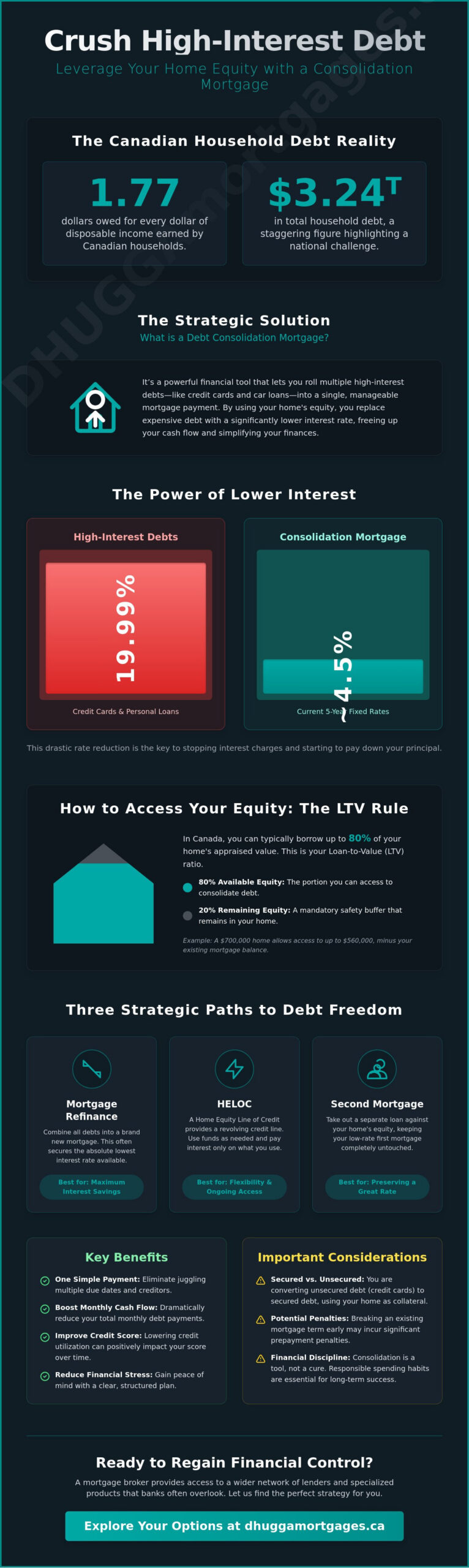
Did you know that Canadian households now owe $1.77 for every dollar of disposable income they earn? With total household debt reaching a staggering $3.24 trillion in early 2026, you aren’t alone if you feel like high-interest credit cards are winning. It’s time to stop the cycle. A strategic debt consolidation mortgage Canada approach lets you use your home equity to crush debt and regain financial control immediately.
We realize how exhausting it is to manage multiple creditors while your balances stay stagnant. You’ve worked hard for your home; it’s time your home worked for you. This guide shows you exactly how to leverage your equity to slash monthly payments and simplify your life with one clear, manageable bill. We’ll break down the 80% loan-to-value rules and show you how to capitalize on the current 2.25% policy rate to secure your financial future. Get ready to breathe easier.
Key Takeaways
- Roll high-interest credit cards and car loans into one low-rate payment to immediately boost your monthly cash flow.
- Compare a standard mortgage refinance against a HELOC to find the most effective debt consolidation mortgage Canada strategy for your goals.
- Navigate the 2026 qualification rules by mastering your Loan-to-Value (LTV) calculations and organizing your documentation.
- Leverage a mortgage broker’s extensive lender network to access specialized products that traditional banks often overlook.
- Simplify your life with a single monthly payment designed to eliminate missed deadlines and reduce financial stress.
What is a Debt Consolidation Mortgage in Canada?
A debt consolidation mortgage Canada is a strategic equity tool for 2026 that allows you to reorganize high-interest liabilities into a single, low-rate home loan. It isn’t just a standard loan. It’s a high-impact financial maneuver. You roll expensive debts like credit cards, car loans, and personal lines of credit into your primary mortgage. The result is immediate. You secure a significantly lower interest rate and stop the bleed of monthly interest charges. This is about taking charge of your finances before the household debt-to-income ratio, which reached 177.2% in late 2025, becomes a burden you can’t carry. By choosing a debt consolidation mortgage Canada, you align your debt with current 5-year fixed rates, which are currently between 4.14% and 4.74%.
How Consolidation Works in the Canadian Market
The process is straightforward and efficient. You access a lump sum of your home’s equity to pay off external creditors in full. Instead of juggling five different due dates, you manage one single payment. In Canada, you can typically refinance up to 80% of your home’s appraised value. This limit ensures you maintain a safety buffer while still accessing the capital needed to clear balances. Understanding What is Debt Consolidation? helps clarify that you are essentially trading unsecured, expensive debt for secured, affordable debt. With the Bank of Canada policy rate holding at 2.25% in June 2026, the spread between mortgage rates and credit card interest is massive. You’re moving from 19% interest to roughly 4.5%. It’s a proactive way to protect your equity and simplify your life.
Debt Consolidation vs. Refinancing: The Key Difference
People often use these terms interchangeably, but there’s a vital distinction. Mortgage refinancing is the mechanism you use to access your equity. Debt consolidation is the specific goal. You aren’t adding new debt to your life; you’re simply moving it to a more efficient environment. This move drastically improves your monthly cash flow. By stretching the repayment of a $30,000 credit card balance over a mortgage term at a lower rate, your required monthly output drops significantly. This gives you the breathing room to actually pay down the principal rather than just treading water with interest-only payments. You gain an immediate edge in your financial planning and see your credit score improve over time as your credit utilization drops. It’s about speed, reliability, and results.
3 Ways to Consolidate Debt Using Your Canadian Home Equity
Choosing the right debt consolidation mortgage Canada strategy depends on your current interest rate and your long-term financial goals. You have three primary paths to leverage your equity. Each offers a different level of flexibility and cost. The Financial Consumer Agency of Canada emphasizes that selecting the right product can save you thousands in interest over time. Whether you want a clean break from your current lender or a flexible line of credit, the goal remains the same: stop high-interest debt from eroding your wealth. You’re moving from a position of stress to a position of power.
The Refinance Strategy for GTA Homeowners
A standard refinance involves breaking your existing mortgage term to start a new one with a higher principal. This is often the most effective way to secure the lowest possible interest rate. For Brampton residents, mortgage refinancing Ontario allows you to lock in a new amortization period. This move significantly lowers your monthly obligation. You must weigh the cost of breaking your current term against the interest savings. If the savings on your credit cards outweigh the prepayment penalty, it’s a win. It’s a bold move that provides immediate relief and a clear path to debt-free living. We make the transition fast and seamless.
HELOCs: Flexibility for Ongoing Debt Management
A Home Equity Line of Credit (HELOC) provides a revolving credit line based on your home’s value. It’s a great tool if you need access to funds over time. HELOCs often offer interest-only payment options. While this helps your immediate cash flow, it requires strict discipline. You don’t want to stay in debt forever. Use the HELOC to systematically pay down credit card balances, then focus on reducing the HELOC principal. With variable rates currently around 3.35%, it’s a powerful alternative to 19% credit card rates. It puts you in the driver’s seat of your repayment schedule.
When a Second Mortgage is the Right Move
If you have a very low interest rate on your first mortgage, breaking it might not make sense. This is where a second mortgage shines. You keep your primary loan intact and add a separate, smaller loan behind it. This strategy is ideal for Mississauga homeowners facing high penalties or those who need urgent funding. It’s also a viable path for those with bruised credit who may need to work with private mortgage lenders Ontario. These loans often have faster approval times, getting you the cash you need to stop creditor calls today. If you’re unsure which path fits your specific situation, speak with a local expert to compare your options side-by-side.
The Pros and Cons of Consolidating Debt into Your Mortgage
Consolidating debt isn’t just about moving numbers. It’s about survival in a high-debt environment. The primary advantage of a debt consolidation mortgage Canada is the massive drop in monthly interest expenses. You’re effectively swapping 20% credit card interest for mortgage rates currently hovering between 4.14% and 4.74%. This shift creates immediate cash flow. You also simplify your life. One payment. One date. No more missed deadlines or predatory late fees. It’s one of the top reasons homeowners refinanced in the past year. We see clients regain their peace of mind the moment those high-interest balances hit zero.
There are trade-offs to consider before you act. Stretching short-term debt, like a car loan or a holiday balance, over a 25-year mortgage term increases the total interest paid over the life of the loan. You must be strategic. Another critical factor is the nature of the debt itself. You are converting unsecured debt into secured debt. This means your home is now the collateral for your previous credit card balances. If you don’t manage the new mortgage payments, you put your property at risk. It’s a serious commitment that requires a proactive mindset and a clear plan for the future. If your primary concern is escaping high-rate card balances, learning exactly how to consolidate credit card debt with your mortgage can help you weigh the costs and benefits with precision before you commit.
The Financial Impact: A 2026 Perspective
In the current 2026 market, the “break-even” point is vital. You must calculate if the interest savings exceed the mortgage discharge fees, which typically range from $350 to $500 in Ontario. Beyond the immediate savings, this move can significantly boost your credit score. By paying off high-balance cards, you drastically reduce your credit utilization ratio. This makes you a more attractive borrower for future opportunities. It’s a double win for your financial health. You gain lower payments today and a stronger credit profile for tomorrow.
Addressing the Risk of Foreclosure
“Am I risking my house?” It’s the most common question we hear. The answer is yes, but only if you don’t change your spending habits. A debt consolidation mortgage Canada is a reset button, not a magic wand. You must implement a strict budget post-consolidation to ensure success. The biggest danger is the “double debt” trap. This happens when homeowners clear their cards and then immediately start charging them again. To succeed, you must be disciplined. Focus on the peace of mind that comes with a streamlined, manageable financial plan. Take control now and protect your equity.
How to Qualify for Debt Consolidation in Ontario
Qualifying for a debt consolidation mortgage Canada requires a clear, methodical approach. You need to know where you stand before you apply. Start by calculating your Loan-to-Value (LTV) ratio. In Ontario, most lenders cap refinancing at 80% of your home’s appraised value. If your home is worth $800,000, your total mortgage cannot exceed $640,000. Next, gather your documentation. You’ll need recent pay stubs, T4s, and current statements for every debt you plan to pay off. Review your credit score early. Look for errors that might drag your numbers down. Finally, compare the penalty for breaking your current mortgage. If you have a fixed-rate loan, the Interest Rate Differential (IRD) penalty can be steep. A broker helps you do the math to ensure the move makes financial sense. We prioritize speed and accuracy in this phase.
Working with a broker gives you a distinct advantage. We access both “A” lenders like big banks and “B” lenders who offer more flexibility. This dual access ensures you don’t get stuck with a single “no” from your primary branch. We realize that your time is valuable. Our process is designed to get you from application to approval with minimal friction. You get the expert guidance needed to navigate the 2026 lending environment with confidence. It’s about securing the best possible terms for your specific financial profile. For Ontario homeowners who want to understand the full mechanics of this approach, our detailed walkthrough on using a home equity loan for debt consolidation breaks down every step of the process.
Credit Score Requirements and “B” Lending
If your score is below 600 in Toronto, don’t panic. Big banks might say no, but the market is wider than just the traditional lenders. We specialize in bad credit debt consolidation mortgage solutions. When your credit is bruised, your home equity becomes the primary compensating factor. “B” lenders and private options focus more on the property value and your ability to pay than a single three-digit number. It’s a proactive way to rebuild. You use your equity to clear the very debts that are dragging your score down. This creates a path back to “A” lending in the future.
The 2026 Stress Test and GDS/TDS Ratios
The 2026 stress test remains a significant hurdle for many. You must prove you can handle payments at a rate higher than your actual contract rate. Lenders look at two key numbers: Gross Debt Service (GDS) and Total Debt Service (TDS) ratios. GDS covers your housing costs like mortgage, taxes, and heat. TDS includes all other debts like car loans and credit cards. For homeowners in Caledon, improving these ratios before applying is vital. Pay down small, high-payment balances first to lower your monthly obligations. This small move can be the difference between an approval and a rejection. Ready to see if you qualify? Contact our team today for a rapid assessment of your equity.
Strategic Debt Management: Why Working with a Broker Wins
Walking into your local bank branch limits you to one set of rules. One product list. One “no” and your plans are stalled. A mortgage broker operates differently. We work for you, not the lender. Choosing a debt consolidation mortgage Canada through a broker means accessing a massive network of “A” lenders, credit unions, and private funds simultaneously. This variety is your biggest advantage. It ensures you don’t just get a loan; you get the specific strategy that maximizes your savings. We handle the negotiations, the paperwork, and the heavy lifting. You get the results. It’s about speed, efficiency, and getting you out of high-interest debt faster than a traditional bank ever could.
Our proactive management style removes the complexity from the application process. We realize that managing multiple creditors is stressful enough. You don’t need a complicated mortgage process on top of it. We streamline every step, from the initial equity assessment to the final closing. This high-energy approach ensures no detail is missed. We look for the “edge” in every file, ensuring your debt is restructured to support long-term wealth building rather than just temporary relief. You gain a partner who values your time and understands the urgency of your financial situation.
The Dhugga Advantage in Brampton and Mississauga
Local expertise matters in the Peel Region. The GTA market moves fast, and your mortgage strategy should too. We specialize in complex files that traditional banks often decline. Whether you’re a newcomer building a future or a business owner needing a self-employed mortgage Canada, we find the path forward. Our deep roots in Brampton and Mississauga allow us to navigate local property nuances with ease. We don’t see a “bruised” file; we see a homeowner ready for a fresh start. We provide the personalized attention your finances deserve.
Next Steps: Taking Action Today
Stop the interest drain today. Every month you wait is another month of 19% interest eating your equity. The first step is a professional equity assessment to see exactly how much cash you can unlock. It’s a clear, no-nonsense look at your financial potential. You can book a consultation with Jaspreet Dhugga to review your options and build a custom roadmap. We’ll help you organize your documentation and prepare your application for a rapid approval. Don’t let stagnant debt balances dictate your future. Take charge of your home equity, crush your high-interest payments, and start building real wealth now. Your financial freedom is just one strategic move away.
Take Control of Your Financial Future Today
High-interest debt doesn’t have to be your permanent reality. By leveraging your home’s equity, you can replace overwhelming credit card interest with a manageable mortgage rate. This move does more than just lower your monthly payments; it simplifies your life into a single bill and sets the stage for a stronger credit profile. Navigating a debt consolidation mortgage Canada requires a partner who understands the local GTA market and the specific 2026 regulatory environment.
Jaspreet Dhugga leads our brokerage with deep expertise in the Brampton and Mississauga regions. We provide the edge you need by accessing extensive private and alternative lender networks that big banks simply can’t reach. We move fast because we know your time is valuable. Our team is dedicated to removing complexity and delivering results that give you immediate peace of mind.
Crush your debt today; contact Jaspreet Dhugga for a custom consolidation plan. You’ve worked hard to build equity in your home. Now, let that equity build a debt-free future for you. We’re ready to start when you are.
Frequently Asked Questions
How much equity do I need to consolidate debt into my mortgage in Canada?
You can typically refinance up to 80% of your home’s appraised value. This means you must maintain at least a 20% equity stake after the new loan is issued. If your property is valued at $600,000, your total debt consolidation mortgage Canada amount cannot exceed $480,000. We’ll help you calculate your exact available equity during your initial assessment.
Will consolidating my debt into my mortgage hurt my credit score?
You might see a minor, temporary dip when a lender performs a hard credit inquiry. However, the long-term impact is overwhelmingly positive. By paying off maxed-out credit cards, you drastically reduce your credit utilization ratio. This is a primary factor in your credit score. Most homeowners see their scores improve significantly within a few months of closing.
What are the fees associated with a debt consolidation mortgage?
Expect to pay for an appraisal, legal services, and potential lender fees. In Ontario, appraisals usually cost between $350 and $550. Legal fees for refinancing typically range from $900 to $1,800 depending on the complexity. If you’re switching lenders, you may also face a mortgage discharge fee between $350 and $500. We provide a clear breakdown of these costs upfront.
Can I consolidate debt if I have bad credit in Ontario?
Yes. We specialize in finding solutions for homeowners with bruised credit. Alternative and private lenders focus more on your home’s equity and the property’s location than a traditional credit score. This approach allows you to clear the very debts that are dragging your score down. It’s a proactive way to reset your finances and move back toward prime lending.
Is it better to get a HELOC or a second mortgage for debt consolidation?
A second mortgage is often the better choice if your first mortgage has a very low interest rate. It allows you to avoid the massive prepayment penalties associated with breaking a fixed-rate term. A HELOC is ideal if you want a revolving line of credit with flexible, interest-only payment options. We’ll compare both strategies to see which one maximizes your monthly cash flow.
How long does the debt consolidation mortgage process take?
A standard consolidation usually takes between two and four weeks from application to funding. This timeline includes the appraisal and legal work. If your situation is urgent, private mortgage options can often close much faster. We prioritize speed and efficiency to get your high-interest debts cleared as quickly as possible.
What happens if I recharge my credit cards after consolidating?
You risk falling into the “double debt” trap. Since your old debt is now secured against your home, adding new credit card balances increases your total financial burden and puts your property at risk. Consolidation is a powerful tool, but it requires discipline. Stick to a strict budget to ensure you don’t undo the progress you’ve made.
Can I include tax arrears or student loans in a consolidation mortgage?
You can include CRA tax arrears, property tax late payments, and most student loans in your debt consolidation mortgage Canada. Clearing CRA debt is especially vital to avoid government liens on your home. Rolling these into your mortgage stops high-interest penalties and brings all your obligations under one low-rate payment. It’s a strategic move to protect your equity.