Jaspreet Dhugga – Mortgage Broker Brampton, GTA And Ontario



Mortgage Broker vs Bank in Toronto: Compare Rates and Costs
- Home
- Mortgage Broker vs Bank in Toronto: Compare Rates and Costs

A bank with a familiar name isn’t automatically the best mortgage fit. If you’re weighing why use a mortgage broker instead of a bank in Toronto, start with lender choice: a bank specialist offers that bank’s products, while a broker can compare options from participating lenders. Approval criteria vary, too, so one lender’s decision doesn’t necessarily predict what another may offer.
It’s understandable to focus on the interest rate, but the full cost and fit depend on more than the advertised number. Fees, mortgage features and how your application meets a lender’s criteria all matter. A lower rate can reduce interest costs, while prepayment privileges, penalty terms and portability affect how well the mortgage works for you over time.
This comparison looks at broker and bank offers across rates, long-term interest costs, fees, lender choices and approval criteria. You’ll see when a broker can broaden your options, when staying with your bank may suit you, and what to weigh before choosing a mortgage for your home in Toronto, Brampton, Mississauga or Caledon.
Key Takeaways
- Compare more than the advertised rate: mortgage features and long-term interest costs can change which offer fits best.
- Understand how broker compensation works and when alternative financing may involve borrower fees.
- A broker can compare options across participating lenders, while a bank specialist focuses on that bank’s products.
- Approval criteria vary by lender, so a decision from one institution may not represent every available option.
Mortgage rates and long-term interest costs
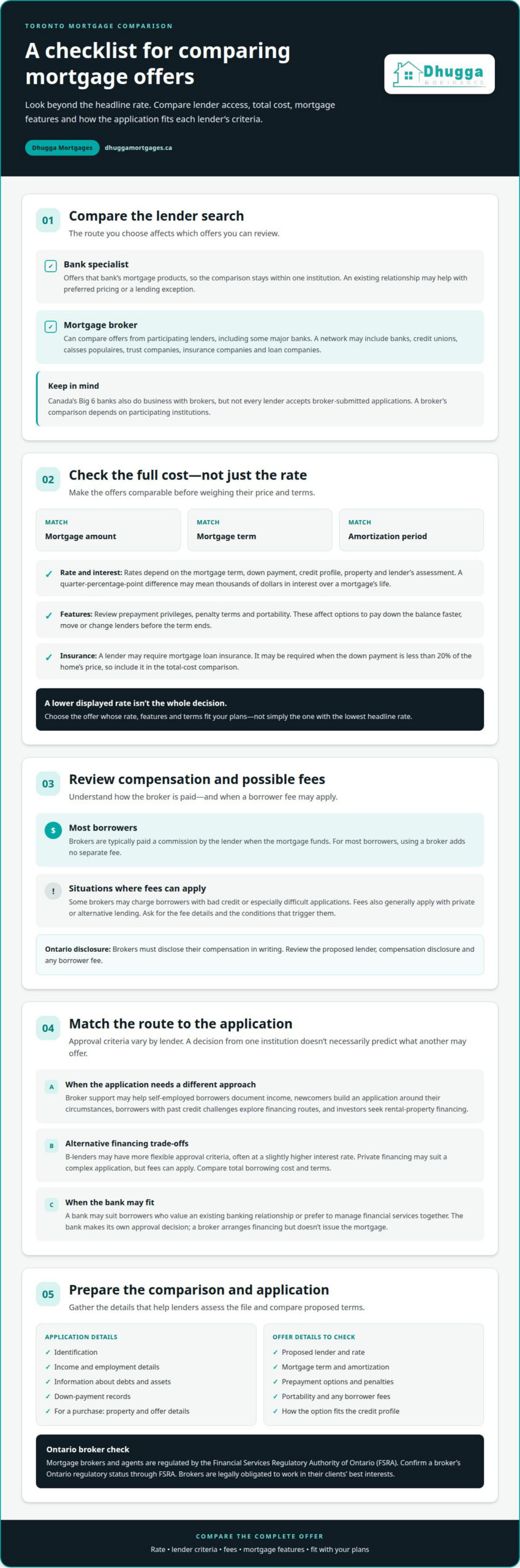
A bank mortgage specialist offers products from the bank that employs them. A mortgage broker can compare offers from participating lenders, including some major banks. That wider search may reveal a rate or mortgage feature that isn’t available in one institution’s offer.
Rates depend on factors such as the mortgage term, down payment, credit profile, property and lender’s assessment. A quarter-percentage-point difference may look small, but even a modest rate gap can mean thousands of dollars in interest over a mortgage’s life. Compare the full offer, not just its headline rate.
| Option | Rate access | Comparison scope | What to weigh |
|---|---|---|---|
| Bank specialist | That bank’s mortgage products | One institution at a time | Rate, features and existing banking relationship |
| Mortgage broker | Offers from multiple participating lenders | Several lender options through one application process | Rate, lender criteria and mortgage terms |
For a fair comparison, line up the same mortgage amount, term and amortization period. Then review interest, prepayment privileges, penalty terms and portability. Choose the offer whose terms fit your plans, not simply the one with the lowest displayed rate.
In Ontario, mortgage brokers and agents are regulated by the Financial Services Regulatory Authority of Ontario (FSRA). Bank employees aren’t subject to Ontario’s mortgage broker licensing regime. Mortgage brokers are legally obligated to work in their clients’ best interests.
To choose and verify a Toronto broker, confirm their Ontario regulatory status through FSRA, then review the proposed lender, rate and mortgage terms. A clear comparison explains how each offer differs, including penalties and prepayment options.
A broker can guide you from the initial application through steps such as the home appraisal. Prepare identification, income and employment details, information about debts and assets, and down-payment records. For a purchase, property and offer details also help support the application.
According to Canada Mortgage and Housing Corporation, a lender may require mortgage loan insurance, or it may be required when the down payment is less than 20% of the home’s price. Include this requirement when comparing the total cost of offers.
Broker compensation and borrower fees
In Canada, mortgage brokers are typically paid a commission by the lender when the mortgage funds. For most borrowers, using a broker therefore adds no separate fee. In Ontario, brokers must disclose their compensation in writing, so you can understand how the proposed mortgage is paid for.
Fees can still apply in particular situations. Some brokers may charge borrowers with bad credit or especially difficult applications. Fees also generally apply when financing comes from a private or alternative lender. Before proceeding, ask for the fee details and the conditions that trigger them.
Broker support can be useful when a standard bank application doesn’t fit your financial situation. For example, brokers may help:
- Self-employed borrowers document income for a lender’s assessment.
- Newcomers build a mortgage application around their financial circumstances.
- Borrowers with past credit challenges explore available financing routes.
- Investors seek financing for rental properties.
Alternative B-lenders may have more flexible approval criteria, often at a slightly higher interest rate. Private financing may also suit a complex application, but fees can apply. Compare the total borrowing cost and terms, not just whether you may qualify.
There are trade-offs. Not every lender accepts applications through brokers, so a broker’s network may not cover the entire market. A broker arranges financing but doesn’t issue the mortgage; the lender makes the approval decision. A bank may suit borrowers who value an existing banking relationship or prefer to manage their financial services together.
Before moving forward, review the proposed lender, compensation disclosure, any borrower fee and the reason that option fits your credit profile. For help assessing a complex mortgage situation, contact Dhugga Mortgages.
Comparing lenders and mortgage products
A broker’s lender network can include banks, credit unions, caisses populaires, trust companies, insurance companies and loan companies. Canada’s Big 6 banks also do business with brokers, so this route doesn’t automatically rule out a major bank. However, not every lender accepts broker-submitted applications. The available comparisons depend on which institutions participate.
Applying directly to a bank keeps your search within that institution’s mortgage products. This may suit someone who values keeping financial services and payments together. An existing relationship may also help with preferred mortgage pricing or a lending exception. One reason to use a mortgage broker instead of a bank in Toronto is the chance to explore participating lenders when another institution may better fit your application.
Compare mortgage structure as well as lender. Terms can range from a few months to five years or longer, and the right fit depends on how long you plan to keep the mortgage. Review prepayment privileges, penalty terms and portability. These features affect your options if you want to pay down the balance faster, move or change lenders before the term ends. They’re also part of why borrowers consider using a mortgage broker instead of a bank in Toronto.
- Bank: Review its available terms and features alongside the value of keeping financial services together.
- Broker: Compare participating lenders, recognizing that some don’t accept broker-submitted applications.
- Either route: Weigh the rate, mortgage features and lender’s approval criteria as one complete offer.
Renewal timing matters, too. Start comparing options a few months before the maturity date rather than waiting for your existing lender’s offer. That leaves time to consider other institutions and assess their terms before deciding. Keep comparisons consistent by reviewing the same mortgage balance, term and relevant features across each offer.
Choose the route that matches your priorities: a bank relationship and its own products, or a broker’s access to participating lenders and their alternatives.
Comparing broker and bank offers
Compare actual mortgage offers, rather than assuming a broker always beats a bank. A Canadian bank may negotiate below its posted rate, while a broker may access lender offers unavailable through a direct application. The key question is which lender offers the strongest fit for your application and plans.
Use a consistent example: a $500,000 mortgage, compared at rates separated by a quarter of a percentage point over a five-year term. That difference changes interest costs, but the exact impact also depends on amortization, payment schedule and mortgage terms. Compare the same assumptions across each offer before weighing the results.
Then review the conditions behind the rate. A low rate can come with different prepayment privileges, penalty terms or portability. A bank may negotiate based on your existing relationship, while a broker may present competing offers and negotiate through lender relationships. Neither route guarantees the lowest rate; the written offer and its conditions matter.
- Rate: Compare the offered rate, not just a posted rate or advertised example.
- Interest: Use the same mortgage amount, amortization and term to assess costs fairly.
- Flexibility: Compare prepayment options, penalties and portability before choosing.
- Lender: Consider approval criteria and whether the lender accepts broker-submitted applications.
Start with the bank’s written offer and compare it with a second mortgage offer. Set aside fifteen minutes to review the rates, features and conditions side by side. If the offers differ, identify whether the change comes from the rate, lender criteria or mortgage flexibility. That makes negotiation more focused, whether you return to the bank or consider another lender.
For a clear comparison of your mortgage options, request a mortgage offer review.
Dhugga Mortgages: Mortgage Refinancing
Dhugga Mortgages can help you compare refinancing options when your current mortgage no longer fits your plans. Reviewing lender terms, interest costs and mortgage features can clarify whether refinancing aligns with your priorities. If managing several debts is part of the picture, debt consolidation may also be relevant.
Bring details about your current mortgage, financial situation and goals. That gives the refinancing discussion a practical starting point, whether you’re considering a change or planning ahead for renewal. The right next step depends on how the available terms fit your needs.
Contact Dhugga Mortgages to discuss your mortgage refinancing options.
Choose the mortgage path that fits your next move
Connect the mortgage decision to what you’re planning. A first home purchase calls for a different conversation than refinancing an existing mortgage. If managing debt is also a priority, debt consolidation may be relevant. Start with the goal you want your mortgage to support.
That’s the practical answer to why use a mortgage broker instead of a bank in Toronto: a broker can help you explore lender options for your situation, while a bank focuses on its own products. Neither route should be chosen by habit alone. Focus on the offer and terms that make sense for your plans.
Dhugga Mortgages offers First-Time Home Buyer Mortgages, Mortgage Refinancing and Debt Consolidation for clients in Toronto, Brampton, Mississauga and Caledon. Bring your priorities and mortgage questions to the conversation, and take the next step with a clearer sense of what you want to explore.
Contact Dhugga Mortgages to discuss your mortgage goals and move forward with confidence.
Frequently Asked Questions
Do all mortgage lenders use the same approval criteria?
No. Each lender assesses applications under its own criteria, so the same borrower may receive different decisions or terms. For example, a bank may decline an application that an alternative B-lender considers, although that lender may charge a higher interest rate. Income structure, credit history, debts, down payment and property details can all affect how an application is assessed.
How do mortgage brokers work in Toronto, Ontario?
A mortgage broker acts as an intermediary between you and lenders rather than issuing the mortgage. In Toronto, the broker gathers your application details and submits them to suitable lenders in their network. They can help move the file through steps such as document review and appraisal. Once the mortgage closes, the lender handles customer service and receives your payments.
Do mortgage brokers charge borrowers fees in Ontario, and how are they paid?
Most borrowers don’t pay a separate fee because the lender typically pays the broker a commission when the mortgage funds. In Ontario, brokers must disclose their compensation in writing. Fees may apply for private or alternative financing, or for a particularly difficult application. Review the written disclosure so you understand any borrower-paid fee and when it applies.
Can Toronto mortgage brokers access lower mortgage rates than banks?
Sometimes, but a lower rate isn’t automatic. A broker may access lender offers or negotiate a discounted rate, while a bank may also negotiate below its posted rate. Compare written offers using the same mortgage details, then assess penalties and flexibility alongside interest. The strongest offer depends on the lender, your application and the mortgage terms.
Which lenders can a mortgage broker access that Toronto banks cannot?
There isn’t one universal list of lenders exclusive to brokers. Broker networks can include credit unions, trust companies, insurance companies, loan companies and alternative lenders, while some major banks also work with brokers. Applying directly to a bank focuses on that institution’s own products. Access varies because some lenders don’t accept applications submitted through brokers.
How do mortgage brokers help self-employed or hard-to-qualify Toronto home buyers?
A broker can look for lenders whose criteria better match a self-employed borrower’s income structure or a buyer’s credit history. For instance, business income may be assessed differently from a regular salary, and one lender’s requirements may not fit the applicant’s records. Brokers can present the financial details to participating lenders and identify options suited to the application.