Jaspreet Dhugga – Mortgage Broker Brampton, GTA And Ontario



Mortgage Pre-Approval in Mississauga and Your Eligibility
- Home
- Mortgage Pre-Approval in Mississauga and Your Eligibility

A pre-approval can sharpen your home-buying budget before you start viewing properties. Applying for a mortgage pre-approval online in Mississauga involves a review of your finances and an estimate of the mortgage amount and rate you may qualify for. Pre-approvals are typically valid for 90 to 120 days, so timing matters as you plan your search.
Getting that clarity early can help you set a realistic price range. The review considers your credit, income, debts and down payment. Lenders may also request documents to support your application. A pre-approval is most useful for setting a budget before your home search, while also accounting for ongoing costs such as property tax, home insurance, heating and condo fees.
This guide explains how online pre-approval works in Mississauga, what credit criteria lenders consider and how applying through a mortgage broker differs from applying directly to a lender. You’ll learn what the process can tell you, what information may be needed and how to choose a next step that fits your home-buying plans.
Key Takeaways
- Time your pre-approval around your home search; it typically remains valid for 90 to 120 days.
- Use the approved amount to set a budget, not as a guarantee of final mortgage approval.
- Understand whether a broker or lender best fits your application and the kind of financing you need.
- Review your credit profile and supporting documents to see how they may affect your eligibility.
Mortgage Pre-Approval Mississauga: Ready to Buy Now?
Applying for a mortgage pre-approval online in Mississauga can help you set a practical home-buying budget before your search. A pre-approval letter records the mortgage amount you may qualify for, along with a potential interest rate and mortgage term. It may also outline estimated payments. Use these details to assess affordability, rather than treating the maximum amount as a target.
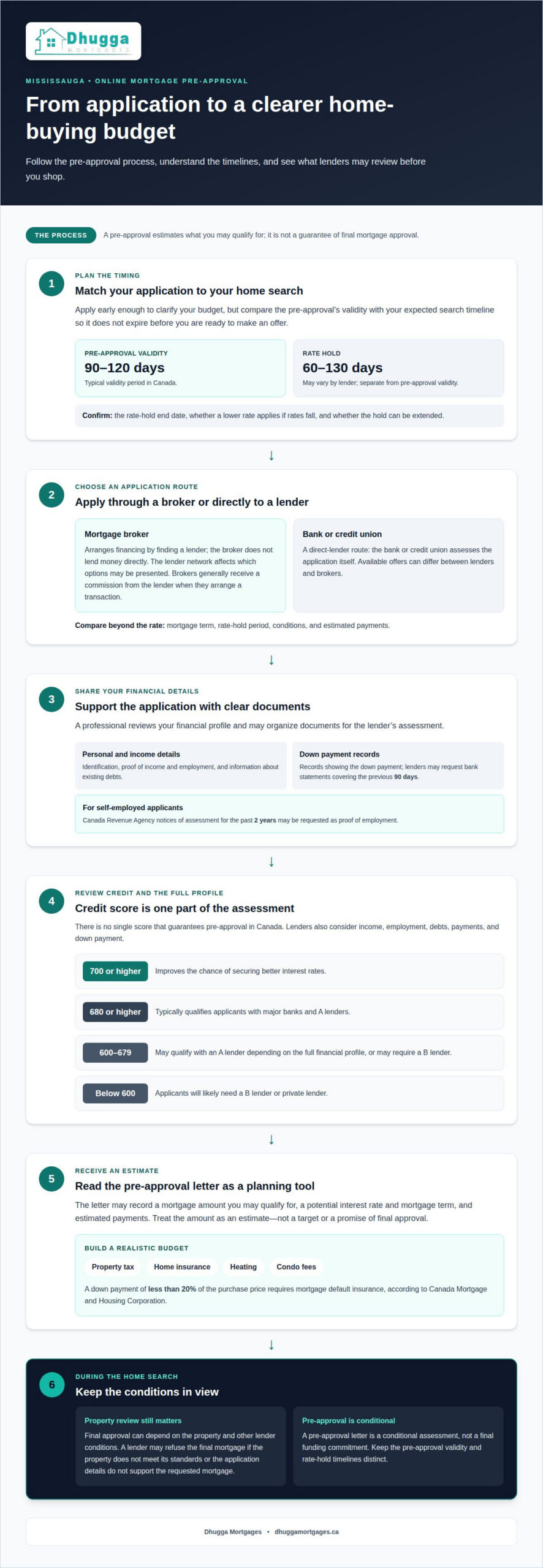
A pre-approval is not a guarantee of a mortgage. The amount is an estimate based on the information reviewed, and final approval can depend on the property and other conditions. In Canada, pre-approvals are typically valid for 90 to 120 days. That validity period is separate from the rate hold, so note both timelines when planning your purchase.
A lender may hold a pre-approved interest rate for 60 to 130 days, depending on the lender. This rate hold can provide protection if interest rates rise during that period. Ask how long the rate is guaranteed, whether a lower rate will apply if rates fall, and whether the hold can be extended. These details affect the value of the rate guarantee.
Plan your application around your home search. A pre-approval obtained too early may expire before you’re ready to make an offer, while applying before viewing homes can clarify your budget. Compare the letter’s validity period with your expected search timeline, then confirm the rate-hold end date. Include recurring costs such as property tax, home insurance, heating and condo fees in your budget.
Your down payment also affects the financing picture. According to Canada Mortgage and Housing Corporation, a down payment of less than 20% of a home’s purchase price requires mortgage default insurance. Factor that requirement into your planning alongside the amount in your pre-approval letter. With the timelines and conditions clear, you can approach a Mississauga home search with a more useful budget, while keeping the distinction between a rate hold and final mortgage approval in view.
Getting pre-approved through a broker or lender: what a professional handles
A mortgage professional reviews your application, organizes supporting documents and helps match your borrowing profile to a lending option. In Mississauga, you can apply directly through a lender or work with a mortgage broker.
Lender networks and mortgage options
A mortgage broker arranges financing by finding a lender, but doesn’t lend money directly. A broker’s lender network affects the mortgage options they can present. A professional reviews your income, debts, down payment and credit details, then identifies options suited to your application. Ask how the available terms, interest rates and estimated mortgage payments fit your buying budget.
Comparing pre-approval offers
Banks, credit unions and brokers offer different routes to pre-approval. A broker submits an application to a lender, while a bank or credit union assesses it directly. Compare more than the interest rate: review the mortgage term, rate-hold period, conditions and estimated payments. Brokers generally receive a commission from the lender when they arrange a transaction. Lender access varies, so available offers may differ.
Reasons a lender may refuse
A pre-approval depends on the information you provide and the lender’s conditions. If your application details don’t support the requested mortgage, or the property doesn’t meet the lender’s standards, the lender may refuse the final mortgage. A mortgage professional can organize your file and clarify the lender’s assessment. A pre-approval letter is a conditional assessment, not a final funding commitment.
Online pre-approval providers in Mississauga
In Mississauga, online applications are available through lenders and mortgage brokers; banks and credit unions are direct-lender options. The professional reviews your documents and submits or assesses the application through the chosen route. Lenders may request bank statements covering the previous 90 days to document a down payment. To discuss your application, connect about online pre-approval.
What credit score is needed for a mortgage pre-approval?
There isn’t one credit score that guarantees mortgage pre-approval in Canada. A score of 680 or higher typically qualifies applicants with major banks and A lenders. Scores from 600 to 679 may still qualify with an A lender, depending on the full financial profile, or may require a B lender. Below 600, applicants will likely need a B lender or private lender. A score of 700 or higher improves the chance of securing better interest rates.
Credit is only one part of the review. A mortgage professional organizes the application so lenders can assess your income, employment, existing debt, payments and down payment alongside your credit score. These details help establish a realistic price range and show whether mortgage payments fit your finances. The interest rate offered can depend on your overall profile, not just your score.
Documents support those details. Applicants commonly provide identification, proof of income and employment, information about debts, and records showing the down payment. Lenders may request bank statements covering the previous 90 days as proof of the down payment. For self-employed applicants, Canada Revenue Agency notices of assessment for the past 2 years may be requested as proof of employment. Clear, consistent documents help the professional present the application accurately.
Timing matters, too. Since a pre-approval is typically valid for 90 to 120 days, organize current documents around the planned home search. If income varies, employment has changed, or the down payment comes from several sources, the professional can identify which records explain the application. That context helps lenders assess the whole file rather than relying on a credit score in isolation. It also gives buyers a more useful basis for setting a price range before making offers.
Mortgage eligibility and credit criteria
Mortgage eligibility depends on your credit history, income, debts, down payment and the property. Together, these factors shape the maximum amount you may qualify to borrow.
Credit checks and score effects
A mortgage pre-approval may involve a credit check that can affect your credit score. Mortgage-related inquiries made within a short window, typically 14 days, are often treated as one inquiry by Canadian credit bureaus. A pre-approval costs the buyer nothing, but applying repeatedly can affect your score: more than three credit checks within six months may lower it. Avoid seeking more than three mortgage pre-approvals in that period.
Credit score requirements
Credit score is one part of the lender’s assessment, alongside income, debts and repayment history. A score of 700 or higher improves the chance of securing better mortgage rates. The score ranges discussed above indicate how applicants may be considered by different lender types, but the broader financial profile also matters. Existing monthly payments and the amount requested can influence whether you qualify and what terms are offered.
Down payment, stress test, and insurance criteria
For a home under C$500,000, the minimum down payment is 5%. For a home priced from C$500,000 to C$999,999, it is 5% on the first C$500,000 and 10% on the remainder. A home priced at C$1.5 million or more requires at least 20% down. According to Canada Mortgage and Housing Corporation, a down payment below 20% requires mortgage default insurance. Lenders also assess affordability under their qualifying criteria, including the stress test, before setting the amount you may borrow.
Borrowing based on income and debts
Your maximum mortgage depends on income, existing debt, down payment and property value. Lenders generally require a gross debt service ratio below 39% and a total debt service ratio below 44% for approval with most major lenders. These measures compare housing costs and total debt obligations with gross income. They help show how monthly payments fit your finances, rather than relying on income alone.
Discuss your mortgage eligibility and the factors shaping your pre-approval.
Dhugga Mortgages: Mortgage Refinancing
Dhugga Mortgages can help you consider mortgage refinancing when reviewing an existing home loan, or First-Time Home Buyer Mortgages as you prepare to buy. The right next step depends on your situation. A pre-approval helps you understand your potential borrowing capacity before a purchase; refinancing addresses an existing mortgage.
If you’re self-employed, a Self-Employed Mortgage may suit your application. If managing multiple debts is part of your financial picture, Debt Consolidation is another option to discuss. These address different needs, so start with your goal and the information a lender will assess, such as income, debts, credit and down payment.
For guidance on which mortgage path fits your plans, contact Dhugga Mortgages.
Make your next mortgage move with a clear plan
Before viewing homes, decide what monthly commitment feels comfortable for your household, rather than focusing only on what a lender may approve. This gives your mortgage professional a useful starting point for discussing options and shaping a plan around your priorities. For a mortgage pre-approval online in Mississauga, share your intended timeline and details that could affect your application, such as changing income or other financial obligations.
Keep your plans flexible as you move from pre-approval toward a specific property. The home you choose and the details of your offer become part of the lender’s assessment. A pre-approval can guide your search, but it doesn’t replace the property-specific review required for a mortgage decision. Clear communication at each stage can help you understand what comes next.
Take the next step when you’re ready to discuss your mortgage plans. Contact Dhugga Mortgages to start the conversation and move forward with a plan that fits your goals.
Frequently Asked Questions
A pre-approval, how does it work?
An online pre-approval begins with an application describing your finances and home-buying plans. A mortgage professional reviews the details and supporting documents, then submits the file to a lender for assessment. The lender’s response may outline a mortgage amount, term and interest rate. Use the letter to guide your search, and update your professional if your income, debts or purchase plans change.
How can a mortgage professional help speed up your pre-approval?
A mortgage professional can organize your application, identify missing information and direct the file to a suitable lender. Having documents ready can make the process faster: an online pre-approval may take as little as an hour, while a complex application may take one to two weeks. Clear details about income, debts and down payment can help prevent delays caused by incomplete or inconsistent information.
Pre-qualification or pre-approval, what’s the difference?
A pre-approval is more thorough than a pre-qualification because the lender examines your personal finances more closely. A pre-qualification gives an initial indication based on the information available, while pre-approval involves a fuller application review. For example, a buyer comparing homes can use a pre-approval to plan with a more informed estimate, while remembering that it remains conditional.
What documents are needed for online mortgage pre-approval in Canada?
Prepare identification, proof of income and employment, details of outstanding debts, and records showing your down payment. Lenders may request bank statements covering the previous 90 days to support the down-payment source. Self-employed applicants may be asked for Canada Revenue Agency notices of assessment for the past 2 years. Consistent documents help the professional present your financial picture clearly to the lender.
How does a mortgage professional arrange online mortgage pre-approval in Mississauga, step by step?
A professional typically moves the application through these stages:
- Collect your financial details, documents and intended purchase plans.
- Review the information for gaps or details requiring clarification.
- Submit your application to a lender for assessment.
- Explain the lender’s response, including its conditions and next steps.
Share any changes to your finances or plans promptly so your application reflects your current circumstances.
How long does online mortgage pre-approval take, and how long is it valid?
An online application may take as little as an hour when required documents are ready; a complex pre-approval may take one to two weeks. In Canada, pre-approvals are typically valid for 90 to 120 days. The interest-rate hold has its own timeframe, which can range from 60 to 130 days depending on the lender. Track both dates when planning your home search.