Jaspreet Dhugga – Mortgage Broker Brampton, GTA And Ontario



Reverse Mortgage Pros and Cons Canada: A 2026 Strategic Guide
- Home
- Reverse Mortgage Pros and Cons Canada: A 2026 Strategic Guide

What if your home could pay you back for all those years of mortgage payments? By the end of 2024, Canadians held over $8.2 billion in reverse mortgage debt. This figure is climbing fast as retirees in the GTA look for ways to offset soaring property taxes. It’s a strategic shift. You need the facts before you act. This guide explores the reverse mortgage pros and cons Canada homeowners are weighing in 2026.
You want to stay in your home. You’ve earned that right. But a fixed pension income makes it hard to keep up with the rising cost of living in Ontario. It’s frustrating to be house-rich but cash-poor. We’ll show you how to realize your retirement goals without moving a single box. You’ll learn how to access tax-free cash and maintain your independence without monthly payments. We’re breaking down current interest rates, “no negative equity” guarantees, and the long-term impact on your estate. It’s time to see if your equity can work as hard as you did. Let’s get to work.
Key Takeaways
- Understand how homeowners 55 and older can unlock tax-free equity while retaining full home ownership and title.
- Evaluate the reverse mortgage pros and cons Canada retirees face to see how eliminating monthly payments can solve immediate cash flow issues.
- Learn why compounding interest and equity erosion are critical factors to weigh against your future inheritance goals.
- Compare reverse mortgages to HELOCs and downsizing to determine the most cost-effective way to fund your retirement in the GTA.
- Assess your long-term residency plans to ensure this strategic financial move aligns with staying in your home for five years or more.
What is a Reverse Mortgage in Canada? 2026 Essentials
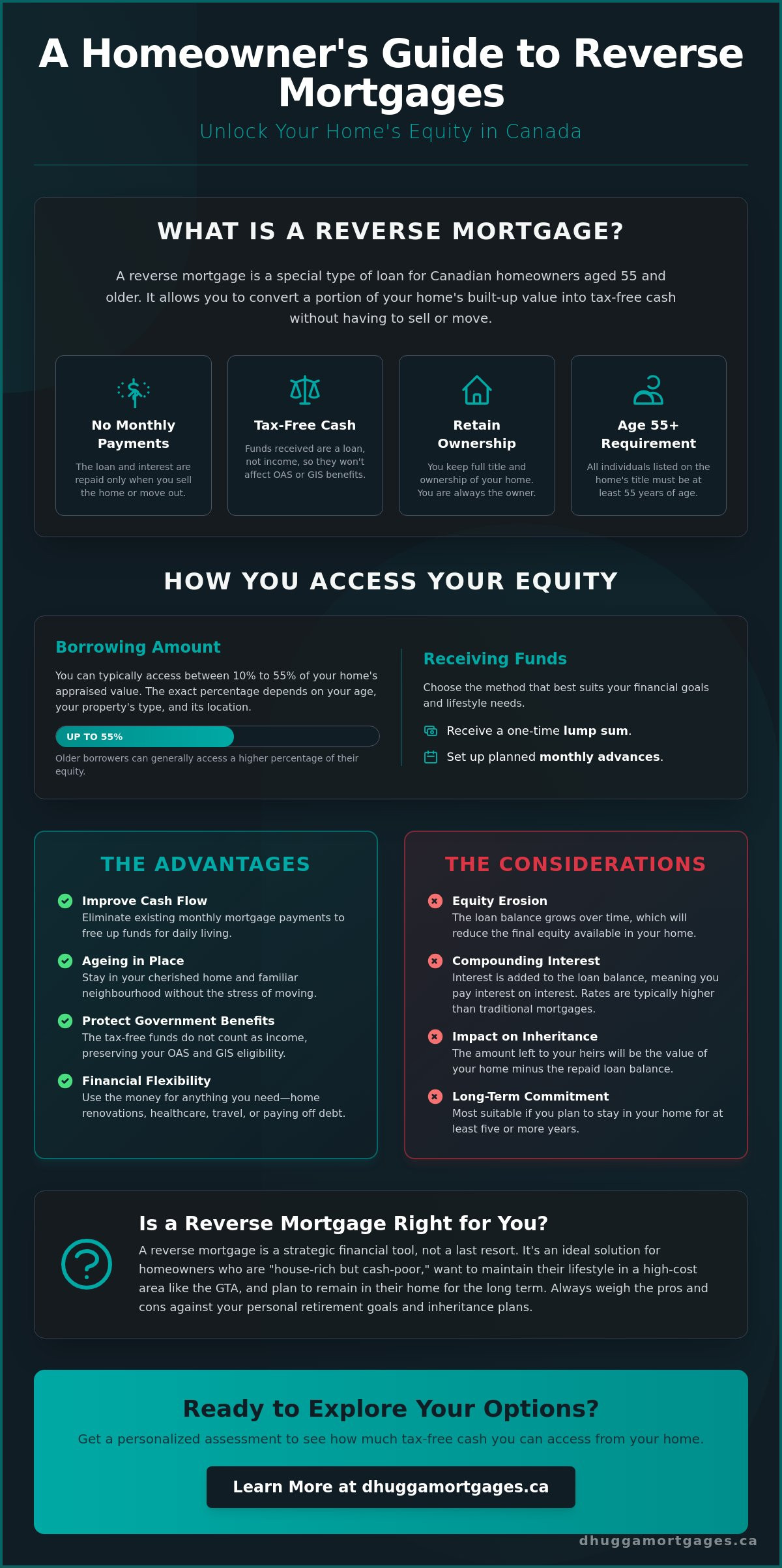
You’ve spent decades building equity. Now, your home can provide the cash flow you need. A reverse mortgage is a non-recourse loan designed exclusively for homeowners aged 55 and older. It allows you to convert a portion of your home’s value into tax-free cash without moving or selling. Unlike a standard mortgage, you don’t make monthly payments. Instead, the interest is added to the loan balance over time. For a foundational look at what is a reverse mortgage, it is essentially a way to access your wealth while staying in place. The loan is only repaid when you move, sell the property, or pass away.
The 2026 regulatory environment in Ontario is designed for borrower protection. The Office of the Superintendent of Financial Institutions (OSFI) has capped the maximum loan-to-value at 65% since late 2023. This ensures a safety buffer for your estate. In the GTA, where property values continue to show strength, this tool is no longer a last resort. It’s a strategic financial move for those weighing the reverse mortgage pros and cons Canada offers. It provides a way to stay in your community while accessing the wealth you’ve already earned.
Eligibility Requirements for Ontario Seniors
Qualifying is straightforward but strict. Every person listed on the home’s title must be at least 55 years old. Your home must remain your primary residence. This means you must live there for at least six months of the year. Lenders also evaluate the property type and location. Detached homes and condos in high-demand areas like Brampton, Mississauga, and Toronto are prime candidates for approval. Your credit score and income are less important than the home’s appraised value and your age. Property types matter. High-density urban areas often see faster processing times.
How Equity Access Works in Today’s Market
Borrowing limits typically range from 10% to 55% of your home’s current value. Your specific limit depends on your age and the property’s appraisal. Older borrowers can generally access a higher percentage of their equity. You have flexibility in how you receive the funds. You can take a single lump sum to pay off existing debt or set up planned monthly advances to boost your pension income. It’s about control. You decide how the money fits your life.
Every dollar you receive is 100% tax-free. Because this is a loan and not income, it won’t trigger clawbacks on your Old Age Security (OAS) or Guaranteed Income Supplement (GIS). This makes it a powerful tool for maintaining your lifestyle in the face of rising Ontario living costs. You keep the cash. You keep the home. You keep your benefits. It’s a simple way to gain an advantage in your retirement years.
The Pros: Why GTA Homeowners Choose Reverse Mortgages
Eliminate your monthly mortgage payments. That is the primary reason GTA homeowners choose this path. It provides an immediate boost to your monthly cash flow. In cities like Brampton or Mississauga, where property taxes and living costs are surging, this liquidity is a lifeline. You stay in the driver’s seat. You maintain full title and ownership of your home. The bank does not take over your property. You simply use the wealth you’ve already built to fund your current lifestyle.
Strategic financial planning is at the core of the reverse mortgage pros and cons Canada discussion. One major advantage is investment protection. If the stock market dips, you don’t want to sell your portfolio at a loss to cover living expenses. Using your home equity allows your investments time to recover. It’s a proactive way to manage your wealth while securing your retirement. You gain access to tax-free funds that can be used for anything from home renovations to private healthcare.
Aging in Place and Home Ownership
Staying in a familiar neighbourhood has immense emotional value. You know your doctors. You know your local shops. You have a community. Moving is not just a physical task; it is a significant life disruption. When you weigh a reverse mortgage vs downsizing, you realize that staying put saves you from land transfer taxes, legal fees, and the stress of a move. You remain the owner. You can find more details on these rights in the Canadian government reverse mortgage information portal. Ownership stays with you, not the lender. You decide when to sell or move.
Financial Flexibility and Government Benefits
Tax-free funds offer a unique edge. Because the money you receive is a loan, it is not taxable income. This is crucial for Ontario seniors. It means your Old Age Security (OAS) and Guaranteed Income Supplement (GIS) payments remain untouched. There are no clawbacks. You can use this cash for anything. Many GTA families are now using these funds to provide a “living inheritance.” This allows children to enter the housing market today rather than waiting decades. It’s a proactive way to support your family’s future while you’re still here to see the impact.
Debt consolidation is another powerful use. Carrying high-interest credit card debt or car loans on a fixed pension is a recipe for stress. Using a reverse mortgage to wipe out those balances simplifies your life. You replace multiple high-interest payments with a single solution that requires no monthly cash outlay. It’s about peace of mind. If you’re ready to see how these benefits apply to your home, reach out for a personalized strategy today. We help you move fast and get results.
The Cons: Understanding the Risks and Costs
Every financial tool has a price. Reverse mortgages are no exception. You aren’t making monthly payments, but the interest doesn’t just disappear. It accumulates. This is a core part of the reverse mortgage pros and cons Canada debate. Expect higher interest rates compared to traditional term mortgages. Lenders wait years for repayment. They take on more risk. You pay a premium for that freedom. It is a strategic trade-off for immediate liquidity.
Setup costs require careful planning. You’ll need to budget for a professional appraisal, independent legal advice, and administrative fees. In 2026, total closing costs typically range between $2,495 and $3,095 depending on the lender. Some providers charge a flat set-up fee around $995 plus title insurance and legal costs. These are upfront expenses you must realize before signing. They are often deducted from the initial loan amount, meaning you receive less cash in hand on day one.
Interest Rates and Compound Growth
Interest compounds monthly. It is added to your principal balance. This creates a snowball effect known as equity erosion. Over a 10-year horizon, rates such as 6.64% or 7.11% can significantly increase your loan balance. You get cash flow today at the expense of your home’s equity tomorrow. Use a reverse mortgage calculator Ontario to see how these rates impact your specific equity over time. Visualization is key to making a confident decision.
Estate Planning and Inheritance Concerns
Inheritance is a common worry for Ontario families. Your heirs will likely receive less equity when the home is eventually sold. That is the reality of equity release. However, the “No Negative Equity Guarantee” protects you. You or your estate will never owe more than the fair market value of the home. When the homeowner passes away, heirs typically have a 120-day window to settle the loan. This usually involves selling the property or refinancing. For more on these rules, consult the Government of Canada guide to reverse mortgages. Knowledge is your best defence against uncertainty.
Reverse Mortgage vs. Alternatives: A Comparison
Don’t limit your options. A reverse mortgage is one tool. It is not the only way. To master the reverse mortgage pros and cons Canada provides, you must weigh the alternatives. Every choice impacts your cash flow. Every choice impacts your estate. You need a strategy for 2026. Let’s look at the facts. Speed and clarity are essential here.
Short-term needs often require different solutions. If you only need capital for a 12-month bridge, private mortgage lenders Ontario provide a fast alternative to the long-term commitment of a reverse mortgage. You might also look at a Second Mortgage. This allows you to keep your existing first mortgage intact while pulling out a specific lump sum for renovations or debt consolidation. It’s a tactical move for specific cash requirements. You keep your current low rate while accessing the equity you need.
Reverse Mortgage vs. HELOC
A Home Equity Line of Credit (HELOC) is a popular choice. It offers lower interest rates and total flexibility. You only pay interest on what you use. But there is a catch. HELOCs require monthly interest payments. For a retiree on a fixed pension, this creates a new monthly bill. It can strain your budget. Qualification is also a major barrier for many seniors.
The federal stress test remains the biggest hurdle for seniors seeking a HELOC. Most major banks will not approve a line of credit if your pension income doesn’t meet their strict debt-service ratios. A reverse mortgage bypasses this. It focuses on your home’s value rather than your monthly paycheque. You get the cash without the monthly payment stress. It’s about accessibility.
Downsizing vs. Staying Put
Selling the house is the traditional retirement move. In the GTA, this is becoming more expensive. Between real estate commissions and the double land transfer tax in Toronto, you could lose a significant portion of your equity just by moving. It is a high-friction process. You also lose your Brampton support network and the home you love. The emotional cost is high.
Staying put often wins the financial race. In many Ontario neighbourhoods, property appreciation continues to outpace the compounding interest of an equity release. You keep the asset. You keep the growth. You keep your community. It is a strategic advantage. If you want to see the numbers for your specific property, contact our team for a side-by-side analysis today. We provide the data you need to move forward with confidence.
Is a Reverse Mortgage Right for Your Ontario Home?
Decision time is here. You’ve looked at the numbers and weighed the risks. Now you must look at your timeline. A reverse mortgage is a long-term financial play. If you plan to stay in your Ontario home for at least five more years, the math often makes sense. If you’re planning to move next year, the setup costs and interest accumulation might outweigh the benefits. You need to balance your immediate cash flow needs against your future estate goals. For a complete deep dive into the mechanics of these loans, review our reverse mortgage Canada pillar.
Choosing the right path requires a clear-eyed look at the reverse mortgage pros and cons Canada offers in the 2026 market. High property taxes in the GTA won’t wait for your pension to catch up. Your equity is a massive, untapped resource that can solve these problems today. It is about taking control. You’ve worked hard for your home. Now it’s time to make your home work for you. Consult with a local expert to navigate the current lending landscape and find the specific product that fits your life.
The Decision Checklist for Seniors
Before moving forward, run through these essential questions. Can you comfortably afford the property taxes and home insurance on your own? Even without a mortgage payment, these obligations remain yours. Have you discussed this strategy with your family or heirs? Transparency now prevents difficult conversations later. Finally, identify your primary goal. Do you need a lump sum to wipe out high-interest debt, or do you prefer a steady monthly “pension” boost to improve your quality of life? Your answer defines the best payout structure for your needs.
How Dhugga Mortgages Simplifies the Process
Working with a Brampton-based broker gives you a distinct advantage over a big bank. We understand the local market trends in Peel Region and the surrounding GTA. We don’t just offer one product. We provide access to multiple lenders, including HomeEquity Bank (CHIP), Equitable Bank, and newer entrants like Bloom Finance. This competition ensures you get the best possible terms for your situation. We move fast. We get results. We prioritize your time.
Our process starts with a no-pressure discovery call. There are no sales pitches here. We provide the facts, run the numbers, and let you decide if the strategy fits your goals. We remove the complexity from the application process so you can focus on your retirement. You get expert guidance from a partner who values your financial independence. If you’re ready to explore your options, book your discovery call today. Let’s realize your retirement goals together.
Secure Your Financial Independence Today
Your home is your greatest asset. It shouldn’t just sit there while you struggle with rising costs in the GTA. You now have the facts on the reverse mortgage pros and cons Canada homeowners must navigate in 2026. You know how to access tax-free cash while keeping your title. You understand the impact of compounding interest on your future estate. Now it’s time to apply these insights to your specific property and goals.
Don’t guess your way through complex financial decisions. We provide the Brampton local expertise you need to move with confidence. Our team offers direct access to all major Canadian reverse mortgage lenders. This ensures you get a competitive edge in the 2026 market. We cut through the noise and provide clear, actionable guidance based on current GTA trends. Your peace of mind is our priority. Let’s get your equity working for you immediately.
Book Your Free Reverse Mortgage Strategy Call Today
You’ve earned a comfortable retirement in the community you love. We’re here to help you make it happen. Let’s build your future together.
Frequently Asked Questions
Can I lose my home if I get a reverse mortgage in Canada?
No, you will not lose your home as long as you meet your basic obligations. You remain the owner on the title and retain full control of the property. To stay in good standing, you must pay your property taxes, keep up with home insurance, and maintain the house in good repair. The “no negative equity” guarantee ensures you can stay in your home as long as you wish.
Is the money from a reverse mortgage taxable in Ontario?
The funds you receive are 100% tax-free. In Ontario, the money is classified as a loan rather than earned income, so it does not need to be reported on your tax return. This allows you to access your wealth without moving into a higher tax bracket or paying a cent to the CRA. It is a powerful tool for maintaining your lifestyle during the reverse mortgage pros and cons Canada evaluation process.
What is the minimum age for a reverse mortgage in Canada?
The minimum age is 55 for all homeowners listed on the title. If you own the home with a spouse or partner, both individuals must be at least 55 years old to qualify. Lenders verify this age requirement during the initial application. Your age is a primary factor in determining how much equity you can access, with older borrowers typically qualifying for higher percentages.
Can I pay off my reverse mortgage early without penalties?
Early repayment usually involves a penalty if done within the first few years. Most Canadian lenders charge a fee if you settle the loan balance early, though many products allow you to repay up to 10% of the principal annually without penalty. If you plan to sell or move within a short timeframe, these costs are a critical factor to realize before signing your agreement.
Will a reverse mortgage affect my Old Age Security (OAS) payments?
Your OAS and Guaranteed Income Supplement (GIS) payments remain untouched. Because the proceeds are tax-free loan advances, they are not considered income for the purpose of government benefit clawbacks. You can boost your monthly cash flow without worrying about losing your federal retirement benefits. It is a strategic way to supplement a fixed pension income.
What happens if the loan balance exceeds the home value?
You are protected by a “No Negative Equity Guarantee” provided by reputable Canadian lenders. If your home value drops or the loan balance grows larger than the property’s worth, the lender absorbs the loss. You or your estate will never owe more than the fair market value of the home at the time of sale, provided you have met your mortgage obligations.
Do I still have to pay property taxes and insurance?
Yes, you must remain current on property taxes and home insurance. These are mandatory requirements for every reverse mortgage in Canada. Failing to pay these costs or neglecting significant home repairs could result in the loan being called due. Lenders require these steps to protect the value of the asset that secures the loan.
Can I get a reverse mortgage if I still have an existing mortgage?
Yes, you can qualify even with an existing mortgage. However, the funds from the reverse mortgage must first be used to pay off that current balance in full. This move is popular among GTA homeowners because it eliminates monthly mortgage payments immediately. Any cash left over after the original debt is cleared is yours to use however you choose.