Jaspreet Dhugga – Mortgage Broker Brampton, GTA And Ontario



Porting a Mortgage in Toronto: Which Loans Can Move
- Home
- Porting a Mortgage in Toronto: Which Loans Can Move

Not every mortgage can move with you. Porting a mortgage in Toronto depends on the lender’s rules and the specific mortgage terms, and you still need approval for the new home. For eligible insured mortgages, a premium credit can be 100% within six months of the original closing.
It’s reasonable to expect your existing rate and terms to carry over, but variable-rate features and borrowing more or less can change how porting works. The details matter, especially when your purchase and sale dates don’t line up.
This guide explains which mortgages may be portable, how variable rates can affect a move, and when insured mortgage premium credits could reduce costs. You’ll also learn what lenders consider when you move to a home with different financing needs, so you can assess how portability fits your next Toronto purchase.
Key Takeaways
- Portability depends on your mortgage terms and lender approval, not simply on moving to a new home.
- Compare the cost of porting with breaking the mortgage, especially if your new home needs a smaller loan.
- Variable-rate terms and extra borrowing can affect how the existing mortgage rate carries over.
- If your mortgage is insured, timing may affect whether a premium credit can reduce the cost of moving it.
What is porting a mortgage?
Porting transfers an existing mortgage’s balance, rate and terms to another property, subject to lender approval. In Toronto, the move also depends on your qualification, contract terms and the timing of both closings.
Lender Qualification and Stress Tests
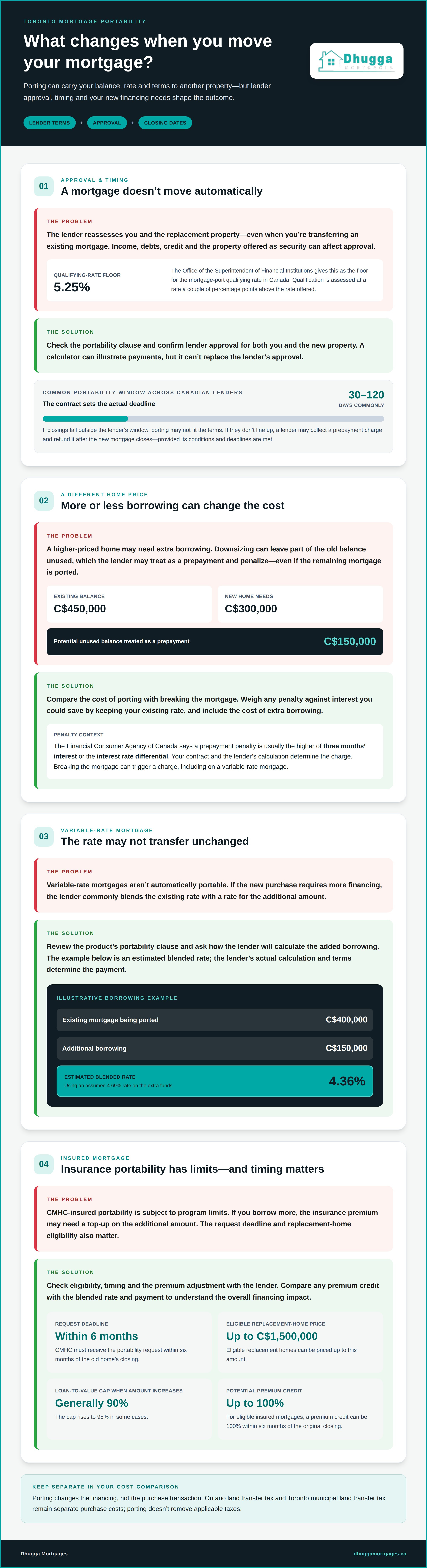
A lender reassesses whether you qualify for the mortgage on the new home, even when you’re moving an existing mortgage. It considers income, debts, credit and the property being offered as security. The stress test also applies: the Office of the Superintendent of Financial Institutions gives 5.25% as the floor for the mortgage-port qualifying rate in Canada. Qualification is assessed at a rate a couple of percentage points above the rate offered. That can affect the payment you’re approved to carry and the amount you can borrow. A calculator can help illustrate payments, but it can’t replace the lender’s approval.
Portability Windows and Closing Dates
A portability window is the lender’s allowed time between selling your current home and closing on the replacement property. Across Canadian lenders, the window is commonly about 30 to 120 days, but your contract sets the actual deadline. The dates matter: a sale and purchase outside that window may not fit the lender’s porting terms. If your closings don’t line up, the lender may collect a prepayment charge and refund it after the new mortgage closes, provided you meet its conditions and deadlines.
Penalties and Lender Approval
Porting may help you avoid a penalty for breaking your existing mortgage, but approval isn’t automatic. The lender assesses you and the new property, and may require an appraisal or decline the property as security. If the new home needs a smaller mortgage, the lender may treat the unused balance as a prepayment and charge a penalty. If the new home costs more, the lender must approve the additional borrowing. Your contract sets the lender’s portability rules and the terms that apply.
Canadian lenders don’t follow one universal portability rule. In Ontario, each lender sets its own terms, including the permitted gap between closings and approval requirements. Read the portability clauses in your mortgage contract: they determine how the lender handles your dates, property and loan amount. Porting a mortgage in Toronto changes the financing, not the purchase transaction. Ontario land transfer tax and Toronto municipal land transfer tax remain separate purchase costs, and porting doesn’t remove applicable taxes.
Can you port any mortgage?
A mortgage may be ported to a more or less expensive Toronto home if the lender permits and approves the transfer. A higher-priced purchase may require additional borrowing; downsizing can leave an unused balance that the lender treats as a prepayment.
Prepayment Penalties
A prepayment penalty is a charge for paying mortgage principal earlier than your contract allows. The Financial Consumer Agency of Canada says the charge is usually the higher of three months’ interest or the interest rate differential. Porting may avoid a penalty on the amount transferred, but your contract and the lender’s calculation matter. Breaking the mortgage instead can trigger a charge, including on a variable-rate mortgage.
Moving to a Higher- or Lower-Priced Home
Moving to a more expensive home can mean borrowing more than your existing balance, with the lender assessing the additional amount. Downsizing can create the opposite issue. For example, if your balance is C$450,000 but the new home needs C$300,000, the C$150,000 difference may be treated as a prepayment. That can trigger a penalty even if the remaining mortgage is ported.
Compare any potential charge with the interest you could save by keeping your existing rate. The difference may make porting worthwhile, but the lender’s penalty calculation and your new borrowing needs affect the outcome.
Before choosing a transfer or refinancing, compare the remaining-term interest, any penalty, and the cost of borrowing extra. Review your mortgage options for a clearer comparison.
Variable-rate mortgage portability
A variable-rate mortgage can move only if its portability terms allow it and the lender approves the transfer. The rate, added borrowing and mortgage insurance can all affect the new financing.
Portability Clauses and Eligible Products
A portability clause explains whether a mortgage product’s balance, rate and terms can transfer to a replacement property. Variable-rate mortgages aren’t automatically portable, so check the contract wording. Even if the product qualifies, the lender still assesses you and the new home. Your income, debts, credit and property value help determine approval and the amount available.
When the purchase requires more financing, lenders commonly blend the existing rate with a rate for the additional amount. For example, a C$400,000 mortgage ported alongside C$150,000 in new borrowing could produce an estimated blended rate of 4.36%, using a simple weighted average and an assumed 4.69% rate on the extra funds. The lender’s actual calculation and terms determine the payment.
CMHC-Insured Mortgage Portability Limits
CMHC-insured portability lets eligible borrowers move mortgage default insurance to a replacement home, subject to program limits. CMHC must receive the portability request within 6 months of the old home’s closing. When the new mortgage amount increases, the loan is generally capped at 90% of the new home’s value, with the cap rising to 95% in some cases. Eligible replacement homes can be priced up to C$1,500,000.
If you borrow more, the insurance premium may need a top-up on the additional amount. A premium credit may offset some of that cost, depending on how soon you port after the original closing. Compare the premium adjustment and credit with the blended rate and payment. This gives you a clearer picture of the overall financing impact, rather than focusing only on the rate carried over.
Porting insured mortgages and premium credits
Mortgage default insurance can move with an eligible mortgage when you buy a replacement home. It commonly applies when the original down payment was less than 20%. A premium credit may reduce the insurance premium on the new home, but the amount depends on when the original mortgage closed. It’s a potential saving, not a cash refund, and it doesn’t remove the need for lender approval.
CMHC may credit 100%, 50% or 25% of the premium previously paid when a mortgage is ported within 2 years of the original closing. The timing affects which credit applies. Within six months of the original closing, the credit can be 100%. After that, a lower credit may apply within the two-year window. The remaining premium, if any, depends on the new mortgage and applicable insurance calculation.
The amount you port matters too. If the new home requires a larger mortgage, the insurance premium may need a top-up on the additional amount, changing the credit’s net value. For example, a borrower moving soon after closing could receive the full eligible credit and still owe a premium adjustment when borrowing more. Compare the credit with the top-up, not just the interest rate.
Timing and approval are central to the calculation. CMHC must receive a portability request within 6 months of the old home’s closing, while the lender assesses the new property, income and mortgage amount. A premium credit doesn’t guarantee the mortgage port or approval. Map the original closing date, replacement purchase and expected loan amount together. This shows whether the credit window aligns with your move and whether extra borrowing affects the savings. Review your insured mortgage port options to understand how the credit and any premium top-up fit your move.
Dhugga Mortgages: Mortgage Refinancing
Dhugga Mortgages can help you assess mortgage refinancing when porting doesn’t suit your plans or the lender’s terms. Refinancing may be worth considering if you’re buying a different home, need a different mortgage amount, or want to compare a new mortgage with the costs of transferring your existing one.
The right option depends on your current mortgage, purchase plans and financial situation. A review can clarify the trade-offs between keeping your existing terms and arranging new financing. If you’re also a first-time buyer or self-employed, those circumstances can shape the mortgage options considered.
For guidance on your next mortgage decision, contact Dhugga Mortgages.
Plan Your Next Mortgage Move
Your next home is an opportunity to make financing fit the life you’re moving into. Before deciding what to do with your mortgage, consider the purchase alongside your broader goals: the payment you want to manage, the funds you may need, and whether keeping your current terms still makes sense. A clear comparison can make porting a mortgage in Toronto a deliberate part of your moving plan, rather than a rushed choice.
Dhugga Mortgages can help you consider Mortgage Refinancing if a new mortgage better fits your plans. First-Time Home Buyer Mortgages may suit a first purchase, while Debt Consolidation can be relevant if managing several debts is part of the picture. The right direction depends on your circumstances and the mortgage options available. You don’t need to choose a path before discussing the options.
Contact Dhugga Mortgages to discuss your mortgage options. Take the next step with a clearer view of your move.
Frequently Asked Questions
Am I able to port if I am building my next home or property?
Yes, construction financing may be compatible with a port, subject to the lender’s terms and approval. For construction financing when porting, funds must begin to be withdrawn within 90 days of selling the existing property, and the new home must be completed within one year. These timelines make the build schedule important. A delayed or reverse port may also be available, depending on the lender’s rules.
Can I take my current mortgage rate to a new house in Canada?
Often, yes, if your mortgage includes portability terms and your current lender approves the move. The existing rate applies to the ported balance, not automatically to every dollar you need for the new home. If you borrow more, the lender may blend that balance with a new rate. For a Toronto purchase, the final rate and payment depend on your mortgage terms and approved amount.
Can an Ontario mortgage be ported to a different lender?
Portability generally means moving your existing mortgage under its current lender’s terms, not transferring the same contract to another lender. If you switch lenders, the new lender assesses a new mortgage application and sets its own terms. The old mortgage may need to be paid out, which can trigger a prepayment penalty. Compare that cost with the new rate and borrowing terms before deciding.
Planning a Move and Want to Keep Your Mortgage Rate?
You may be able to keep your current rate by porting, but start with your mortgage contract’s portability terms and the lender’s approval criteria. For example, if your move requires extra borrowing, part of the new mortgage may have a different rate. Coordinate the sale and purchase dates, too. A rate worth keeping can still be a poor fit if your total financing needs change.
Port, Break or Wait for Renewal?
Compare the total cost and timing of each option. Porting may preserve terms on the transferred balance; breaking the mortgage can bring a prepayment penalty; waiting until renewal may avoid ending the current term early. Waiting works only if your moving timeline allows it. Consider the remaining term, the new home’s mortgage needs and the cost of any additional borrowing before choosing.
What happens if the lender declines a port application?
If the lender declines the port, the existing mortgage won’t transfer to the new property under that application. Your mortgage contract still governs what happens when you sell your current home, including any amount payable and possible prepayment charge. You may need different financing for the purchase or a revised timeline. Compare those options with the cost of paying out the existing mortgage.