Jaspreet Dhugga – Mortgage Broker Brampton, GTA And Ontario



Best Mortgage Broker for Self-Employed: Your 2026 GTA Strategic Guide
- Home
- Best Mortgage Broker for Self-Employed: Your 2026 GTA Strategic Guide

Your tax return says one thing. Your bank account says another. Why does your bank treat your business success like a financial liability? In 2026, the best mortgage broker for self-employed professionals is the one who looks past the tax forms to see your actual cash flow. You’ve built something great in the GTA. You shouldn’t be penalized for your entrepreneurship. Stop settling for automatic rejections from big banks that don’t understand your hustle.
We know the frustration of fluctuating income and the impact of the new 42% debt-to-income limits. This guide promises to show you how to secure competitive C$ rates and flexible terms through expert B-lender and private market strategies. We’ll break down the latest 2026 regulations and show you exactly how to position your business for a fast approval. Get the professional edge you need to win in today’s market. Secure your future now.
Key Takeaways
- Stop letting rigid bank algorithms dictate your homeownership. Learn how a specialized broker navigates A, B, and private lending options for you.
- Move beyond Line 15000 on your tax return. Discover how the best mortgage broker for self-employed professionals uses “stated income” to prove your true buying power.
- Compare custom-tailored solutions against one-size-fits-all bank products. Understand why a strategic B-lender approval beats a bank rejection every time.
- Build a bulletproof application with our 2026 checklist. Gather your T1 Generals and bank statements to prove consistent cash flow and speed up your approval.
- Leverage “income engineering” to get tough files approved in the GTA. Partner with local experts who value your time and deliver results quickly.
Why Finding the Best Mortgage Broker for Self-Employed Professionals is Essential in 2026
The 2026 lending environment isn’t friendly to entrepreneurs. Traditional banks rely on automated systems. These algorithms are designed for T4 employees with predictable paycheques. If you’re self-employed, your income rarely fits into a standard box. This is where the best mortgage broker for self-employed individuals makes a critical difference. They don’t just submit paperwork. They architect a financial narrative that highlights your business’s true health. You need someone who speaks the language of lenders and understands the nuances of your balance sheet.
A professional mortgage broker acts as your strategic intermediary. They understand that a T1 General only tells half the story. While a bank clerk might see a low net income and hit “decline,” a specialist analyzes your gross revenue, depreciation add-backs, and retained earnings. They know how to package your application to prove stability. They focus on actual cash flow. They ensure your hard work translates into a mortgage approval that reflects your success.
The “Taxable Income” Trap for Ontario Entrepreneurs
You work hard to minimize your tax bill. It’s smart business. However, those legal write-offs that save you thousands in April can kill your mortgage application in June. The CRA sees your net income after expenses. Most big banks use that same figure to calculate your debt-to-income ratio. In 2026, with the debt-to-income limit tightened to 42%, this trap is more dangerous than ever. Many business owners in Brampton and Mississauga find themselves “stuck” at their local branch. They have the capital, but they don’t have the “qualified income.” A specialist sees the real numbers. They bridge the gap between your tax efficiency and your borrowing needs.
The Broker Advantage: Access to Non-Traditional Lenders
The best mortgage broker for self-employed clients has deep roots in the alternative market. They maintain relationships with credit unions, Alt-A lenders, and private funds that banks can’t access. As of June 2026, traditional lending standards have tightened significantly due to OSFI regulations. This has sparked a massive shift toward B-lenders. These institutions offer more flexibility. They might look at 12 to 24 months of business bank statements instead of just tax returns. Private mortgage options also serve as a vital bridge for newer businesses that haven’t hit the two-year mark yet. You need a partner who knows which door to knock on when the big banks close theirs. Get the edge you deserve.
How Specialized Brokers Calculate Self-Employed Income for Ontario Mortgages
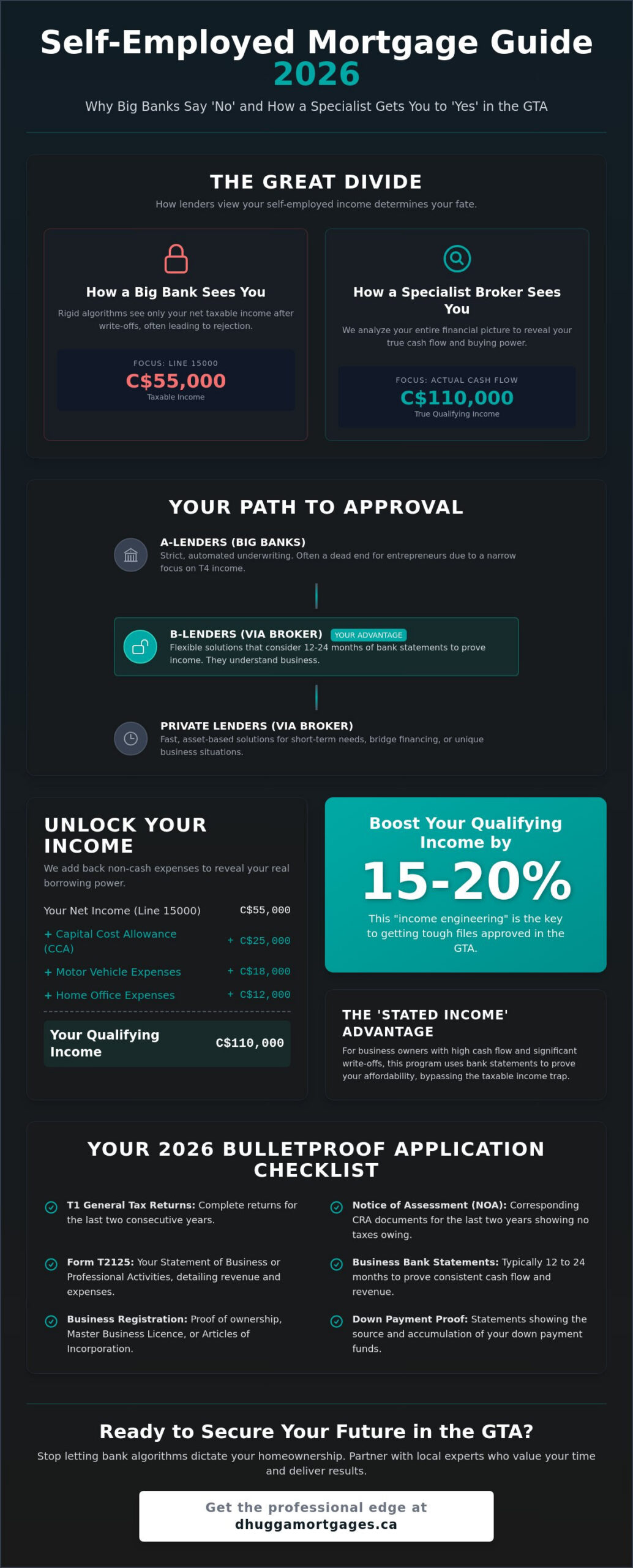
Banks look at Line 15000 on your tax return and stop there. That is a mistake. The best mortgage broker for self-employed professionals looks deeper. They focus on “reasonableness” and actual cash flow. In 2026, lenders have tightened standards, but specialized brokers know how to use your Form T2125 (Statement of Business or Professional Activities) to find hidden qualifying income. We don’t just look at the bottom line. We look at the growth of your business.
Brokers typically use a two-year average of your net income to smooth out the natural ups and downs of running a business. If your income is growing, we can often use the most recent year’s figures or even your business bank statements to tell a more accurate story. Your business structure matters. Sole proprietors are calculated differently than incorporated professionals who pay themselves a mix of salary and dividends. We know how to optimize both for maximum borrowing power. We ensure your business success is reflected in your application.
Unlocking Borrowing Power with “Add-Backs”
Banks see expenses. We see qualifying potential. Certain non-cash expenses like depreciation or Capital Cost Allowance (CCA) can be added back to your taxable income. We also look at home office expenses and motor vehicle write-offs. These are legitimate business costs that don’t actually reduce your ability to pay a mortgage. Add-backs are the secret weapon for self-employed mortgage qualification. By adding these back, we can often boost your qualifying income by 15% to 20% compared to a standard bank assessment.
The “Stated Income” Program Explained
In 2026, “stated income” programs remain a vital tool for GTA entrepreneurs. These programs are designed for business owners who have significant write-offs but high cash flow. You don’t just “state” a number. The broker validates it for “reasonableness” based on your industry and 6 to 12 months of business bank statements. The trade-off is clear. You’ll likely need a larger down payment, often 20% to 35% depending on the lender. However, the speed and flexibility are worth it. It’s about getting the deal done quickly. For business owners whose tax returns significantly understate their true earnings, exploring a mortgage for self-employed with no proof of income can open doors that traditional documentation programs cannot.
If you’re tired of being told “no” by your bank, it’s time for a strategy that works. You can speak with our team to see which calculation method fits your business best. We specialize in finding the edge that big banks miss. Let’s get your application moving today. Your entrepreneurship is an asset, not a hurdle.
Comparing Mortgage Brokers vs. Big Banks for Business Owners
Big banks love pay stubs. They hate complexity. If you’re a business owner in Brampton or Mississauga, your file is almost certainly “complex” by their standards. Traditional institutions offer one-size-fits-all products. If you don’t fit their rigid 2026 criteria, you’re out. The best mortgage broker for self-employed entrepreneurs takes the opposite approach. We offer custom-tailored solutions. We don’t just look at what’s on the shelf at one bank. We look at the entire Canadian lending landscape to find the right fit for your specific business structure.
Negotiation power is the real advantage. We don’t just hit “submit” on an application. We advocate for your business viability directly to underwriters. We explain the story behind the numbers. While a bank’s computer might flag your low taxable income as a risk, we highlight your retained earnings and gross revenue. This proactive advocacy often turns a “no” into a “yes.” We also protect your credit score. Applying at multiple banks leads to multiple credit pulls. We perform a single pull and use it to shop your file across dozens of lenders. It’s faster. It’s cleaner. It’s more efficient.
Chasing the lowest advertised rate can be a trap. In 2026, those “teaser” rates often come with impossible qualification hurdles for the self-employed. A slightly higher B-lender rate is always better than a bank rejection. It gets you into the home. It allows you to build equity in a GTA market where the average price sits around C$1,069,700. We focus on the total cost of borrowing, not just the headline number.
B-Lenders and the “Alt-A” Market in the GTA
B-lenders are the sweet spot for many Ontario business owners. These institutions offer flexible income verification, such as bank statement programs. Expect to see a lender fee, typically between 1% and 2%, which is common in the alternative market. This isn’t a permanent solution. We treat B-lending as a strategic bridge. We help you secure the home now, then work on a two-to-three-year plan to transition you back to an A-lender as your business documentation matures.
When to Consider Private Mortgage Solutions
Sometimes you need speed over everything else. Private lending is ideal for short-term needs or “fix-and-flip” business models. If you’re looking for fast capital without the red tape of traditional banks, Private Mortgage Lenders Ontario can provide the liquidity you need. The key is the exit strategy. We never put you into a private loan without a clear path out. Whether it’s through a future refinance or the sale of an asset, we ensure your short-term financing serves a long-term goal.
Checklist: Preparing Your Application for a Self-Employed Mortgage Specialist
Preparation is the difference between a fast approval and a frustrating delay. The best mortgage broker for self-employed professionals needs a clean, organized file to advocate for you effectively. Don’t wait for the lender to ask. Be proactive. A sharp package shows stability and professionalism. It gives the underwriter confidence in your business’s longevity. Use this essential 2026 checklist to get your documents in order before you apply.
- Two years of full T1 General tax returns: Include all pages, not just the summary. Lenders look for consistency and income types.
- Corresponding Notices of Assessment (NOAs): These prove you don’t owe the CRA. Any outstanding tax debt is an immediate red flag.
- 6 to 12 months of business bank statements: This is your proof of cash flow. It validates that your business generates the revenue you claim.
- A brief “Business Profile”: Draft a one-page summary. Explain your industry, how long you’ve been operating, and your primary client base.
- Updated GST/HST filings: Ensure all filings are current and paid. Lenders often verify this as a condition of approval.
- Articles of Incorporation or Business License: Legal proof that your entity is registered and active in Ontario.
The Power of the “Income Narrative”
Numbers tell a story, but you need to provide the context. In 2026, lenders prioritize growth trends over a single high-earning year. If your net profit dipped because you invested in new equipment or a major rebranding, explain it. This is an investment, not a loss. For freelancers and consultants, a “proof of work” portfolio or a list of active contracts can be the deciding factor. It proves your income is sustainable and predictable. Business owners with heavy write-offs who struggle to show qualifying income on paper may also benefit from understanding how a mortgage for self-employed with no proof of income works through bank statement programs and alternative lender approvals in Ontario.
Down Payment Requirements for Entrepreneurs
Your down payment determines your path. For “stated income” programs, a 20% down payment is typically the minimum threshold. This higher equity stake offsets the risk of lower documentation. If you’re short on cash but have property, consider Mortgage Refinancing Ontario to unlock equity from your current home for your next purchase. If you’re receiving a gifted down payment, ensure you have a signed gift letter and proof of the wire transfer. Lenders in Ontario are strict about the paper trail for these funds.
Don’t leave your approval to chance. An organized application is a successful application. You can submit your documents for a strategic review and let our team find the best path forward for your business. Start your journey today. Get the professional edge you need to win.
Strategic Financing with Dhugga Mortgages: Your GTA Self-Employed Experts
Jaspreet Dhugga and the team understand that your time is your most valuable asset. We don’t waste it. In the high-stakes GTA market, you need a partner who moves as fast as your business does. We’ve built a reputation as the best mortgage broker for self-employed professionals by doing what big banks won’t. We use a proactive approach called “income engineering.” This isn’t about cutting corners. It’s about deep analysis of your financial statements to find every dollar of qualifying power. We look at your gross revenue, your add-backs, and your business trajectory. We bridge the gap between your tax efficiency and the lender’s requirements.
Our advantage lies in our proprietary network. We have direct access to GTA-based private and alternative lenders who specialize in entrepreneur-led files. These lenders understand that a business owner’s income isn’t always linear. While a bank’s algorithm sees a risk, our partners see an opportunity. We negotiate on your behalf. We advocate for your business’s success. We ensure you get the competitive edge you deserve in a market where the average home price reached C$1,069,700 in May 2026. You deserve a mortgage that recognizes your hard work.
Local Expertise in the Brampton and Toronto Markets
From the growing communities in Caledon to the competitive core of downtown Toronto, we know the local property nuances. Every neighbourhood has different lending appetites. We help you navigate these local variables with confidence. If you’re a first-time business owner looking to stop renting, our guide to First Time Home Buyer Mortgage Ontario provides the roadmap you need. We offer tailored solutions for medical professionals, IT consultants, and tradespeople. Your industry has unique financial patterns. We make sure your mortgage strategy reflects them perfectly.
Ready to Secure Your Best Rate?
Stop waiting for a bank to realize your value. Generic bank assessments shouldn’t stop your homeownership goals. We provide a personalized mortgage strategy that respects your entrepreneurship. Our commitment is simple: transparency, speed, and professional guidance. We remove the complexity so you can focus on growing your business. The 2026 market is moving fast. Don’t get left behind. Contact the self-employed mortgage specialists at Dhugga Mortgages now to start your application. Experience the difference that local expertise and a proactive approach can make. Your success is our priority.
Take Control of Your GTA Mortgage Strategy Today
The 2026 GTA housing market doesn’t wait for anyone. Rigid bank algorithms shouldn’t be the reason you miss out on your next property. You’ve seen how “income engineering” and strategic B-lender access can turn a tax-efficient business into a qualified mortgage applicant. It’s about looking beyond the T1 General to find your true borrowing power and securing your spot in the market.
As a top-rated Brampton mortgage brokerage, we specialize in stated income programs and B-lender approvals. We provide direct access to over 50 institutional and private lenders. This gives you the competitive edge needed to navigate today’s tighter regulations. Finding the best mortgage broker for self-employed professionals means choosing a partner who values your time and understands your hustle.
Don’t let another bank rejection slow your momentum. Book a Strategic Consultation with our Self-Employed Mortgage Team now. Let’s build a plan that works for your business and your future. Your hard work has earned this. We’re ready to make it happen. Your entrepreneurship is your greatest asset; let’s use it to get you home.
Frequently Asked Questions
Can I get a mortgage if I have been self-employed for less than two years?
Yes, you can secure a mortgage with less than two years of self-employment history by using alternative or private lenders. While traditional banks strictly require a 24-month track record, many B-lenders accept 6 to 12 months of consistent business activity if you are in the same industry as your previous T4 employment. You will likely need a strong “income narrative” and a larger down payment to offset the perceived risk of a newer business.
What is a ‘stated income’ mortgage and do I qualify in Ontario?
A stated income mortgage allows you to qualify based on a reasonable estimate of your earnings rather than the net income shown on your tax returns. In Ontario, this program is designed for business owners who have high gross revenue but significant legal tax write-offs. To qualify, your stated income must be “reasonable” for your industry and supported by 6 to 12 months of business bank statements showing consistent cash flow.
Are mortgage rates higher for self-employed individuals in 2026?
Rates are not automatically higher just because you are self-employed, but your qualification path determines the final cost. If you qualify with an A-lender using full documentation, you can access 5-year fixed mortgage rates around 4.09%. If your file requires a B-lender for more flexibility, expect rates to be slightly higher than the current prime rate of 4.45%, plus a typical lender fee of 1% to 2%.
Do I need a specialized mortgage broker if I have a high credit score?
Yes, because a high credit score does not solve the income verification hurdles that often stop bank applications. Even with a score above 750, a traditional bank will still penalize you for low taxable income on your NOAs. The best mortgage broker for self-employed clients focuses on “packaging” your total financial picture. We ensure underwriters see your retained earnings and gross revenue, not just the bottom line on your tax return.
What documents do I need to prove my income as a freelancer?
Freelancers need to provide two years of full T1 General tax returns and their corresponding Notices of Assessment. You should also prepare 6 to 12 months of business bank statements to prove consistent cash flow. Providing copies of active contracts or a “proof of work” portfolio helps prove your income is stable and recurring. Lenders in 2026 also verify that your GST/HST filings are current and paid in full.
Can I use my business bank statements instead of tax returns for a mortgage?
You can use business bank statements instead of tax returns through specialized “Alt-A” or bank statement programs. These lenders analyze your actual deposits over a 12 to 24 month period to determine your qualifying income. This is a powerful tool for GTA entrepreneurs who have high gross revenue but low net income due to business expenses. It bypasses the rigid “Line 15000” requirement that traditional banks use for qualification.
How much down payment do I need as a self-employed home buyer in the GTA?
The minimum down payment follows standard Canadian rules: 5% on the first C$500,000 and 10% on the remainder up to C$999,999. However, for homes over C$1,000,000, which is common since the GTA average price is C$1,069,700, a full 20% is required. If you are using a stated income program or a B-lender to qualify, expect a minimum down payment requirement of 20% to 35% regardless of the purchase price.
What are ‘add-backs’ and how do they help me qualify for a larger mortgage?
Add-backs are non-cash business expenses that a broker adds back to your net income to increase your qualifying power. Common examples include depreciation, capital cost allowance, and certain home office or motor vehicle expenses. By using add-backs, the best mortgage broker for self-employed professionals can often increase your qualifying income by 15% or more. This allows you to borrow a larger amount without having to change your tax filing strategy.