Jaspreet Dhugga – Mortgage Broker Brampton, GTA And Ontario


Down payment assistance Toronto: How to apply and combine options
- Home
- Down payment assistance Toronto: How to apply and combine options
The strongest down payment assistance in Toronto may come from combining options, not relying on one program. Eligible first-time buyers can use a First Home Savings Account (FHSA) and the RRSP Home Buyers’ Plan for the same home, alongside Ontario and Toronto land transfer tax rebates. The Canada Revenue Agency says the FHSA annual contribution limit is C$8,000, and the Home Buyers’ Plan lets eligible buyers withdraw up to C$60,000 from an RRSP.
Saving for a home can feel like a steep hurdle, but understanding which options add to your savings, provide tax relief or have separate eligibility rules can help you plan. This guide explains how down payment assistance in Toronto works, how eligible options may be combined, and which federal programs could support a purchase. It also covers what to prepare and how mortgage guidance can help you assess the financing side of your plan.
Key Takeaways
- Start by mapping your savings, eligibility and purchase timeline so you can identify which support options fit your situation.
- Assess how registered savings plans and local tax rebates may work together, and plan for each option’s rules.
- Separate active federal programs from discontinued ones before building your down payment plan.
- Compare Toronto-specific assistance with federal options to see which steps can strengthen your overall purchase budget.
1. How to apply for down payment assistance
Start by identifying support that fits your purchase. In Toronto, options may include first-time buyer land transfer tax rebates, registered savings plans and assistance programs, each with its own eligibility rules. Eligibility often depends on whether you qualify as a first-time buyer and meet the specific program’s requirements.
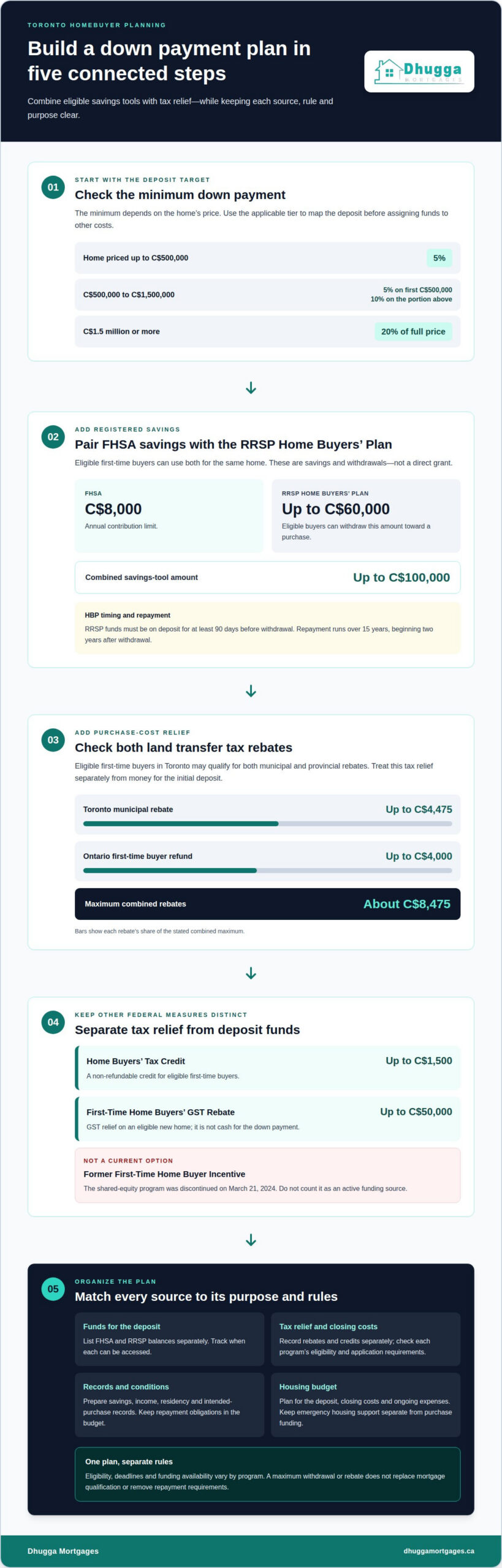
Next, calculate your minimum down payment. According to the Government of Canada, the minimum is 5% for a home priced up to C$500,000. For a home priced between C$500,000 and C$1,500,000, it is 5% on the first C$500,000 and 10% on the portion above that, according to the Government of Canada. A home priced at C$1.5 million or more requires 20% of the full price, according to the Government of Canada.
Then organize your application around the program’s criteria. Prepare records that show your savings, income, residency and intended purchase. The Canada Revenue Agency sets the First Home Savings Account’s annual contribution limit at C$8,000. Include FHSA information when planning the funds available for your purchase.
Income and home price limits depend on the specific program; there isn’t one shared threshold for every Toronto option. The amount also varies: eligible first-time buyers may receive a Toronto municipal land transfer tax rebate of up to C$4,475. Ontario’s first-time buyer land transfer tax refund is up to C$4,000.
Repayment, interest and resale rules depend on how assistance is structured. A tax rebate is different from a loan, so review the program agreement for repayment obligations or conditions related to selling the home. Deadlines and funding availability also vary by program, so submit each required application during its intake period. Keep your purchase timeline, approval requirements and application documents organized so you can consider assistance alongside mortgage financing in Toronto.
2. Combining down payment assistance options
Build a package by separating funds for the deposit from tax relief and housing support. Eligible Ontario first-time buyers can use an FHSA and the RRSP Home Buyers’ Plan for the same home, for up to C$100,000 combined. That figure combines savings tools, not a direct grant, so plan for each account’s eligibility criteria and withdrawal rules.
Toronto buyers may also qualify for both provincial and municipal first-time buyer land transfer tax rebates. Together, the maximum rebates are about C$8,475. Treat this tax relief as a separate part of your purchase budget, rather than assuming it is cash available for the initial deposit. The rebates may help manage purchase expenses, while registered savings provide funds toward the down payment.
Use a simple sequence to coordinate each support program:
- List your FHSA and RRSP balances separately from any rebate or financial assistance.
- Match each source to its purpose, eligibility criteria and application requirements.
- Keep income and savings records organized, and track when funds can be accessed.
- Build your housing budget around the deposit, closing costs and ongoing expenses.
Keep emergency support separate from home-purchase funding. Toronto’s Housing Stabilization Fund provides money for emergency housing needs to people receiving Ontario Works, ODSP income support or qualifying Emergency Assistance. It addresses housing stability, not a stated home-purchase deposit. Don’t count it as down payment funds without confirming that the program permits this use.
Government support can also serve different needs. A disability-related income support program may affect household finances, but it doesn’t automatically make a household eligible for a homeownership program. Assess each application against its own income, residency and purchase criteria. A mortgage review can help connect your available funds with your borrowing plan; discuss your mortgage options as you map out the purchase.
3. Federal down payment assistance options
Canada’s Home Buyers’ Plan (HBP) lets eligible buyers use retirement savings toward a purchase. According to the Canada Revenue Agency, a homebuyer can withdraw up to C$60,000 from an RRSP toward a down payment. RRSP funds must be on deposit for at least 90 days before withdrawal. Repayment runs over 15 years, beginning two years after withdrawal.
That maximum is a withdrawal, not a grant. Include future repayments in your household budget alongside mortgage payments and other housing expenses. The HBP can help bridge a deposit gap, but it doesn’t remove the need to qualify for mortgage financing. For independent cash flow needs or personal borrowing separate from property financing, platforms like ILoveYourLoans provide installment and personal loan options.
Don’t count the former First-Time Home Buyer Incentive as a current source. It offered 5% or 10% of a home’s purchase price through a shared-equity mortgage, but the federal program was discontinued on March 21, 2024. Its past terms included repayment after 25 years or when the property was sold, whichever came first. That history differs from active options such as the HBP.
Two other federal measures may matter to a purchase budget. The Home Buyers’ Tax Credit is a non-refundable credit worth up to C$1,500 for eligible first-time buyers. The First-Time Home Buyers’ GST Rebate can provide up to C$50,000 in GST relief on an eligible new home. Tax relief can reduce costs, but it isn’t the same as cash available for the down payment.
Keep federal support separate from City of Toronto and Ontario land transfer tax rebates. They serve different purposes and have separate application criteria. If a family member contributes to your deposit, a lender may require a signed letter confirming the money is a gift, not a loan. Track each source and its paperwork before applying, so your funds are documented and your purchase plan accounts for repayment obligations.
4. What down payment assistance programs are available to homebuyers in Toronto, Ontario?
Toronto buyers can consider federal savings and withdrawal programs, provincial and municipal tax relief, and support for eligible new homes. These options work differently: some help buyers access their own funds, while others reduce taxes or purchase costs. The down payment assistance Toronto buyers may qualify for depends on their eligibility and the type of home they plan to purchase.
Ontario’s first-time buyer land transfer tax refund and the City of Toronto’s municipal rebate may both apply to a qualifying purchase. They address separate taxes, and together the maximum rebates are about C$8,475. Treat this tax relief as a reduction in costs, not cash set aside for the deposit. Check how each rebate fits your transaction budget.
Federal options include the First Home Savings Account and the RRSP Home Buyers’ Plan. Eligible first-time buyers may use both for the same home, subject to each program’s rules. The First-Time Home Buyers’ GST Rebate may also provide relief on an eligible new home. It reduces GST rather than supplying cash directly for a down payment.
To assess down payment assistance Toronto residents could use, sort potential funds by purpose. Identify savings or withdrawal amounts that can go toward the deposit, then account separately for rebates that reduce taxes. Your home type, buyer status and transaction details determine which options may fit. Keep supporting records together as you prepare applications.
Some Toronto supports address housing emergencies rather than homeownership. The Housing Stabilization Fund helps people receiving Ontario Works, ODSP income support or qualifying Emergency Assistance with emergency housing needs. The Toronto Rent Bank provides grants to eligible residents who need help with a rental deposit. Neither is a home-purchase down payment program.
For a first-time buyer, the next step is connecting eligible funds with mortgage financing. Plan your first-time home purchase financing with your available options in view.
Dhugga Mortgages
Dhugga Mortgages can help connect your down payment plan with the mortgage financing needed to buy a home. Turn to the team once you’ve identified potential savings or rebates and want to understand how they fit your borrowing picture. A First-Time Home Buyer Mortgage can help you assess financing as a first-time buyer, while New to Canada Mortgages may suit newcomers planning a purchase.
Bring details about your funding sources, expected purchase costs and income to the discussion. This helps clarify how available funds and mortgage qualification work together. If you’re self-employed or have existing debt, those details also shape the financing conversation. The goal is a clearer picture of next steps, not a promise of program approval or a particular mortgage outcome.
Contact Dhugga Mortgages to discuss your home financing plan.
Make your next move with a clear financing plan
A down payment assistance plan in Toronto is only one part of buying a home. The next step is to connect funds you may access with a mortgage plan that fits your income, existing obligations and purchase goals. Bring these details into one conversation before making decisions that affect your budget.
Dhugga Mortgages can help you consider First-Time Home Buyer Mortgages alongside your broader financing needs. If you have existing debt or expect your mortgage needs to change, Mortgage Refinancing and Debt Consolidation are also available options. Start the discussion with your circumstances and the outcome you’re working toward.
Contact Dhugga Mortgages to discuss your options and take a confident next step toward your home purchase.
Frequently Asked Questions
How to Apply for Down Payment Assistance Programs?
Apply to each program separately because savings plans, tax rebates and housing supports have different processes. First, identify programs that fit your purchase and buyer status. Then organize your purchase details, income records and proof of available funds. Keep copies of applications and decisions together. For example, track a land transfer tax rebate separately from the funds you plan to use for your deposit.
Does the government give you money for a down payment in Ontario?
Some government programs provide tax relief or access to savings, but not every option is a direct down payment grant. Ontario’s first-time buyer land transfer tax refund and Toronto’s municipal rebate reduce tax payable on an eligible purchase. Federal tools such as the FHSA and Home Buyers’ Plan use your own savings. The former federal First-Time Home Buyer Incentive was discontinued on March 21, 2024.
What about family gifts?
A family gift may contribute to your down payment if the lender accepts it as a genuine gift rather than a loan. The lender may require a signed gift letter confirming the funds don’t need to be repaid. For example, a relative giving money toward your purchase should document the gift clearly. Include the source and intended use of the funds when organizing your mortgage application.
Does the City of Toronto offer a down payment assistance loan, and what are its terms?
The City of Toronto offers a municipal land transfer tax rebate for eligible first-time buyers, not a down payment assistance loan. The rebate reduces tax payable on a qualifying home purchase, so it doesn’t create a loan balance or repayment schedule. Keep it separate from a down payment loan offered through a housing program, which may have its own eligibility and repayment conditions.
Can first-time homebuyers in Toronto combine municipal, provincial, and federal assistance?
Eligible buyers can combine certain options, subject to each program’s rules. For example, an eligible Ontario first-time buyer may use an FHSA and the RRSP Home Buyers’ Plan for the same home. Municipal and provincial land transfer tax rebates may also both apply to a qualifying Toronto purchase. Treat withdrawals and rebates as separate sources because they affect different parts of your purchase budget.
What down payment assistance programs are available in Ontario for Toronto buyers?
Toronto buyers can consider the FHSA, RRSP Home Buyers’ Plan, Ontario’s first-time homebuyer land transfer tax refund and the City of Toronto’s municipal land transfer tax rebate. Eligible buyers of qualifying new homes may also benefit from the First-Time Home Buyers’ GST Rebate. These options serve different purposes, so the home type, buyer eligibility and funds needed at closing help determine which may fit.