Jaspreet Dhugga – Mortgage Broker Brampton, GTA And Ontario



The Ultimate First Time Home Buyer Checklist for Ontario in 2026
- Home
- The Ultimate First Time Home Buyer Checklist for Ontario in 2026

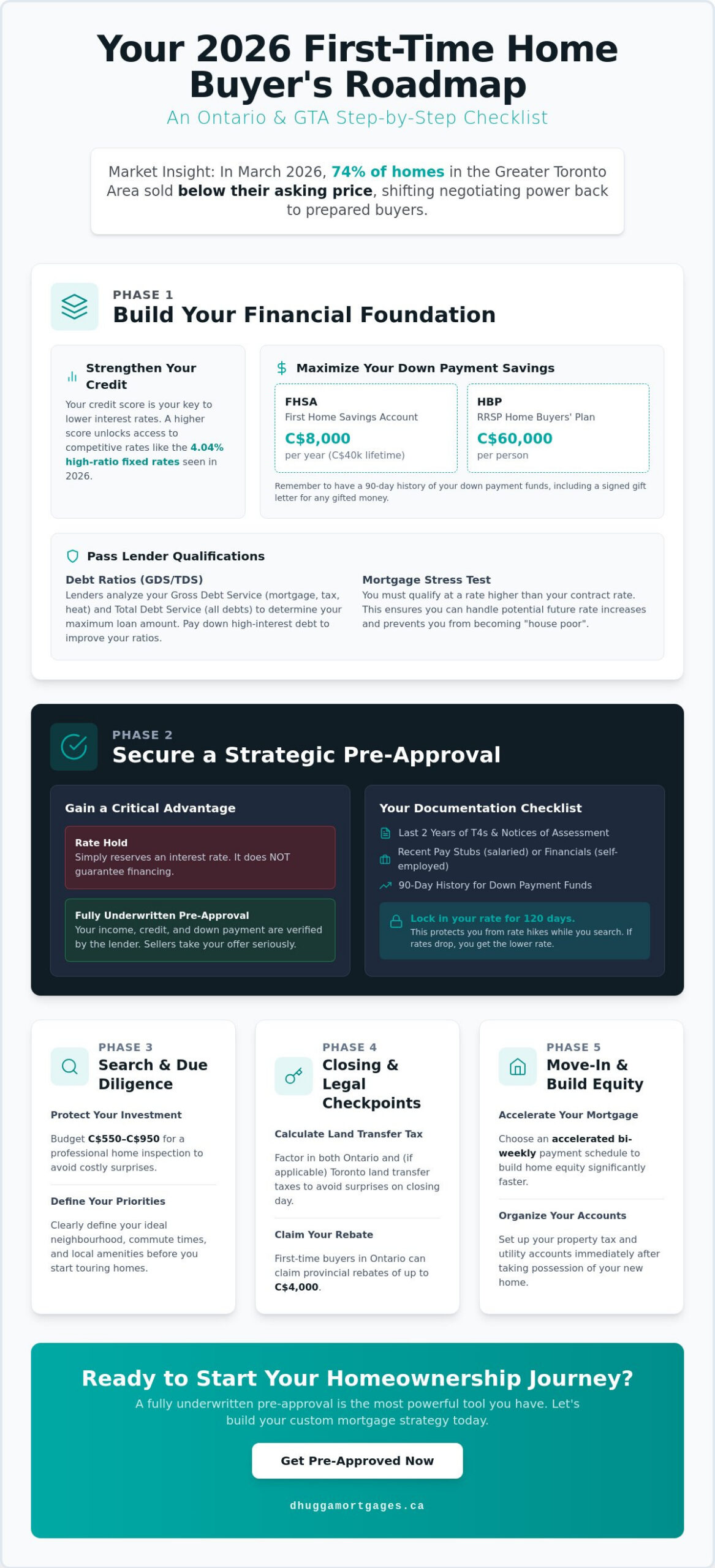
Did you know that 74% of homes in the Greater Toronto Area sold below their asking price in March 2026? The market is shifting. Negotiating power is finally moving back to the buyer, but you must be ready to move. Buying your first home in Ontario often feels like a high-stakes gamble. You’re likely worried about the high cost of living or getting lost in the fine print of government grants. It’s a lot to manage. This first time home buyer checklist Ontario removes the complexity. It puts you in control of your financial future.
We know you want to avoid hidden closing costs and the stress of multiple offer battles. You deserve a streamlined process that leads straight to your front door. This guide promises a clear financial roadmap and the legal insights you need to close with confidence. We’ll show you how to maximize your C$8,000 annual FHSA contribution and leverage the current 4.04% high-ratio fixed rates. We are mapping out every step from mortgage pre-approval to the final handshake. Your path to homeownership starts right here.
Key Takeaways
- Maximize your down payment by combining the FHSA and RRSP Home Buyers’ Plan. Realize how your credit health directly impacts your ability to secure 2026’s most competitive rates.
- Gain a strategic advantage with a fully underwritten pre-approval. This essential step in your first time home buyer checklist Ontario ensures you’re ready to act when the right GTA property appears.
- Protect your investment by budgeting C$550 to C$950 for a professional home inspection and defining your neighbourhood priorities before you start touring.
- Eliminate closing day stress by calculating Ontario and Toronto land transfer taxes while claiming available provincial rebates of up to C$4,000.
- Build equity faster after move-in by selecting an accelerated bi-weekly mortgage payment frequency and organizing your property tax accounts immediately.
Phase 1: Building Your Financial Foundation
Stop guessing about your budget. The first step on your first time home buyer checklist Ontario isn’t scrolling through listings. It’s auditing your finances with clinical precision. Your credit score is your most powerful tool. It determines your interest rate. A higher score gives you a competitive edge. It opens doors to the 4.04% high-ratio fixed rates seen in May 2026. If your score is lagging; fix it now. Low scores lead to higher costs. High scores lead to savings.
Organize your down payment funds today. Whether you’re using personal savings or gifted funds from family; you need a clear paper trail. Lenders require 90 days of bank statements to verify the source of your money. If you’re using gifted money; you’ll need a signed gift letter. Don’t wait until you find a house to gather these documents. Speed is everything in the Ontario market. Having your paperwork ready removes friction during the approval process.
You must also pass the 2026 stress test. Even with stable rates; lenders qualify you at a rate higher than your actual contract rate. This ensures you can handle future fluctuations. This calculation dictates your maximum purchase price. It’s a necessary reality check. It prevents you from becoming “house poor” in a high-cost environment like the GTA.
Maximizing the FHSA and RRSP Home Buyers’ Plan
The 2026 First Home Savings Account (FHSA) is a critical advantage. You can contribute up to C$8,000 annually. The lifetime limit is C$40,000. It’s tax-free in. Tax-free out. Smart buyers combine this with the RRSP Home Buyers’ Plan (HBP). The HBP allows you to withdraw up to C$60,000 per person. A couple could potentially access over C$136,000 for a down payment by 2026. Be mindful of the timeline. The FHSA must be used within 15 years of opening the account. Plan your entry accordingly. To understand exactly how to stack these benefits for maximum impact, explore the full breakdown of first time home buyer programs Ontario offers in 2026.
The Reality of GDS and TDS Ratios in Ontario
Lenders use Gross Debt Service (GDS) and Total Debt Service (TDS) ratios to cap your borrowing. GDS covers your mortgage; property taxes; and heating. TDS adds your other debts like car loans or credit cards. In the GTA; high property taxes can quickly shrink your buying power. The Canada Mortgage and Housing Corporation (CMHC) sets guidelines that most lenders follow. To boost your ratios; pay down high-interest credit cards first. This proactive move increases your eligibility immediately. It’s about maximizing every dollar of your income.
Phase 2: Securing Your Strategic Mortgage Pre-Approval
Don’t treat pre-approval as a suggestion. In Toronto’s high-velocity market; it’s your primary weapon. Sellers will ignore your offer if you haven’t verified your funding. A comprehensive first time home buyer checklist Ontario must distinguish between a simple rate hold and a fully underwritten pre-approval. A rate hold just parks a number. It doesn’t guarantee you the loan. A fully underwritten pre-approval means a lender has already vetted your income; credit; and taxes. It means you are ready to close with confidence. Understanding exactly how mortgage pre-approval for first time buyer status works gives you a critical edge over competing offers in the GTA.
Working with a mortgage broker gives you an immediate edge. We don’t just check one bank. We scan over 50 different lenders to find your best fit. This includes major institutions; credit unions; and private lenders. We do the heavy lifting to ensure your mortgage matches your long-term wealth goals. If you want to move fast in the GTA; securing a professional mortgage strategy is the first step toward a successful bid.
The Documentation Checklist for Ontario Lenders
Lenders demand proof. You need your last two years of T4s and Notices of Assessment (NOAs). Salaried employees must provide recent pay stubs. Self-employed buyers need to show consistent income through business financial statements. Every lender requires a 90-day history for your down payment. This prevents money laundering and ensures the funds are yours. There are also specialized paths for newcomers to Canada that require less Canadian credit history. Gathering these documents early prevents delays when you find the perfect home.
Locking in Your Rate: The 120-Day Advantage
Volatility is the enemy of the first-time buyer. A 120-day rate lock protects you from sudden spikes. In 2026; rates like the 4.04% five-year fixed are attractive; but they aren’t guaranteed forever. If market rates drop after your approval; you’ll typically receive the lower rate automatically. This is your safety net.
Protect your status during this phase. Do not finance a new vehicle. Do not quit your job. Do not maximize your credit cards. Any major change to your debt-to-income ratio can void your pre-approval instantly. When budgeting for new builds; realize the GST/HST New Housing Rebate can change your total cash requirement significantly. Keep your financial profile static until the keys are in your hand. This discipline ensures your closing goes off without a hitch.
Phase 3: The Property Search and Due Diligence
The hunt begins. Don’t let excitement cloud your judgment. Define your “must-haves” versus “nice-to-haves” before stepping into a single open house. In 2026; Ontario’s inventory has increased significantly; giving you more leverage than in previous years. This stage of your first time home buyer checklist Ontario is where you separate emotion from investment. Focus on structural integrity over cosmetic finishes. A fresh coat of paint can hide deep issues.
A home inspection is your best defense. Expect to pay between C$550 and C$950 for a professional evaluation in the Greater Toronto Area. This is a small price to pay to avoid a C$20,000 foundation repair. If you are looking at condos in Mississauga or Toronto; the status certificate is your legal bible. It reveals the building’s financial health and legal standing. You must understand the Agreement of Purchase and Sale (APS) before you sign. It is a binding contract. For a broader view of the journey; Forbes’ First-Time Home Buyer’s Guide provides excellent context on managing these early search phases.
Navigating the Agreement of Purchase and Sale
Your offer needs protection. Include conditions for financing; home inspection; and status certificate review. Firm offers are tempting in competitive pockets; but they are incredibly risky. If your financing falls through on a firm offer; you could lose your entire deposit. Pay close attention to the irrevocable date. This is the deadline for the seller to accept your offer. Your deposit; typically 5% of the purchase price; must be ready in a liquid account immediately upon acceptance.
Condo vs. Freehold: The Hidden Cost Checklist
Freehold homes and condos have different financial profiles. For a freehold in Brampton or Caledon; you are responsible for everything. Roof; furnace; and windows are on your tab. Budget for ongoing maintenance. Condos offer predictable monthly fees; but you must know what they cover. Some include all utilities and insurance; others do not. Review the reserve fund carefully. A low reserve fund often leads to “special assessments.” These are surprise lump-sum payments for major building repairs. Always factor these potential costs into your monthly cash flow model.
Phase 4: Closing Costs and Legal Checkpoints
Closing day is the finish line. Don’t trip here. Your first time home buyer checklist Ontario must include a rigorous budget for closing costs. Expect to pay between 1.5% and 4% of the purchase price in addition to your down payment. On an average Ontario home priced at C$900,161; that means budgeting up to C$36,000 for various fees. These are out-of-pocket expenses. You cannot roll them into your mortgage. You need liquid cash ready to move. This is about being proactive and avoiding last-minute stress.
Ready to lock in your financial plan? Contact Dhugga Mortgages to ensure your closing costs are fully calculated before you sign your offer. We help you map out every dollar so there are no surprises on closing day.
The Ontario Land Transfer Tax Rebate Explained
Land Transfer Tax (LTT) is often the largest closing cost. However; first-time buyers have a major advantage. You can claim a provincial rebate of up to C$4,000. If you are buying within the City of Toronto; you are also eligible for a municipal rebate of up to C$4,475. Combined; this is nearly C$8,500 in savings. To qualify; you must be at least 18 years old. You must be a Canadian citizen or permanent resident. Most importantly; you must never have owned a home anywhere in the world. Your lawyer applies this rebate directly at the time of transfer. It reduces the cash you need to bring to the table immediately.
Title Insurance and Legal Protection
Protection is non-negotiable. Title insurance is your primary shield against title fraud and existing liens on the property. Your lawyer will perform a title search to ensure the seller has the legal right to sell the home. They also look for outstanding work orders or property tax arrears. Once these searches are clear; your lawyer receives the mortgage instructions from your lender. They coordinate the transfer of funds and ensure the deed is registered in your name. This legal heavy lifting is what ensures your investment is secure from day one.
You should also prepare for the “Statement of Adjustments.” This document is a final ledger between you and the seller. It balances the books for items the seller has already paid for in advance. This includes pro-rated property taxes; utilities; or even a full tank of home heating oil. Your lawyer will provide a “Trust Ledger” a few days before closing. It shows the exact amount of the bank draft you need to provide. Review this carefully. Ensure all pro-rated costs align with your first time home buyer checklist Ontario. High-velocity markets like the GTA require this level of detail to ensure a smooth transition.
Phase 5: The Move-In and Wealth Management Strategy
You have the keys. The boxes are unpacked. Now; the real wealth building begins. This final phase of your first time home buyer checklist Ontario shifts from acquisition to management. Automate your property tax payments. Confirm your home insurance. Most Ontario lenders demand insurance proof before releasing funds. Don’t delay. Start strong. Efficiency today prevents friction tomorrow.
Managing Your New Mortgage for Maximum Savings
Accelerated bi-weekly payments are your best friend. They shave years off your amortization. You make 26 half-payments a year. This equals 13 full payments instead of 12. It’s a simple move with massive long-term savings. Use your prepayment privileges. Most contracts allow 10% to 20% principal paydowns annually. Direct your tax refunds or bonuses here. Every extra dollar reduces your interest burden. Build an emergency fund immediately. A C$1,500 furnace repair shouldn’t derail your plan. Stay proactive.
Leveraging Your Home Equity in the Future
Your home is a strategic asset. As equity grows; new doors open. You might eventually need a Home Equity Line of Credit (HELOC). It’s perfect for funding renovations or your next investment property. We also specialize in mortgage refinancing and debt consolidation. If rates drop or debts pile up; we find the edge. This is how you build a real estate portfolio. Your first home is just the beginning.
The Dhugga Advantage is a long-term partnership. We don’t just close the deal and disappear. We monitor the market for you. We track your equity growth. We alert you to new opportunities. Your first time home buyer checklist Ontario is complete; but your financial journey is just starting. We are your proactive guides. Your success is our track record.
Take Command of Your Ontario Home Purchase
Buying your first home is a strategic financial milestone; not just a transaction. You now have the tools to maximize your C$40,000 lifetime FHSA limit and claim your C$4,000 provincial land transfer tax rebate. This first time home buyer checklist Ontario ensures you move with speed and precision. You know how to audit your credit; secure a verified pre-approval; and manage your mortgage for long-term equity growth. Every step you take today builds the foundation for your future wealth.
Don’t leave your success to chance. Jaspreet Dhugga and our team of specialists focus on GTA first-time buyer programs. We provide direct access to over 50 Canadian lenders; ensuring you get the competitive edge you deserve. We remove the complexity so you can focus on finding the right property. Our process is fast; reliable; and built for the modern buyer.
Get Your Fast-Track Pre-Approval Started with Dhugga Mortgages Today.
The Ontario market is waiting. Take the first step with total confidence; knowing you have a seasoned local expert in your corner. Your new home is within reach.
Frequently Asked Questions
What is the minimum down payment for a first-time home buyer in Ontario?
The minimum down payment depends on the purchase price. You need 5% for the first C$500,000 and 10% for the portion between C$500,000 and C$999,999. If the home costs C$1,000,000 or more; a full 20% down payment is mandatory. This is a key entry on any first time home buyer checklist Ontario. Ensure your funds are liquid and verified 90 days before you offer.
Do first-time home buyers pay land transfer tax in Ontario?
Yes; but you receive significant rebates to offset the cost. Eligible first-time buyers get a provincial rebate of up to C$4,000. If you buy in the City of Toronto; you can claim an additional municipal rebate of up to C$4,475. Your lawyer applies these credits on closing day to reduce your total cash requirement. It’s a major financial advantage for new market entrants.
How much are closing costs in Ontario for 2026?
Budget between 1.5% and 4% of the home’s purchase price for closing costs. These expenses include land transfer taxes; legal fees; title insurance; and home inspections. On a C$900,000 property; expect to pay C$13,500 to C$36,000. These are out-of-pocket costs. You cannot add them to your mortgage. Keep this cash separate from your down payment to ensure a smooth closing.
Can I use my RRSP for a down payment on my first home?
Yes; the Home Buyers’ Plan (HBP) allows you to withdraw up to C$60,000 from your RRSP tax-free. If buying with a partner; you can combine withdrawals for a total of C$120,000. The funds must be in your account for at least 90 days before withdrawal. You have 15 years to repay the amount starting the second year after your purchase. It’s a powerful tool for building a larger down payment.
What is the First Home Savings Account (FHSA) and how does it work?
The FHSA is a registered savings plan that combines the benefits of an RRSP and a TFSA. You can contribute up to C$8,000 per year with a lifetime limit of C$40,000. Contributions are tax-deductible; and withdrawals for your first home are tax-free. It’s the most efficient way to save for a home in 2026. You can even combine FHSA funds with your RRSP HBP withdrawal for maximum impact.
How long does a mortgage pre-approval last in Ontario?
A mortgage pre-approval typically lasts between 90 and 120 days. This period includes a rate hold that protects you from market volatility. If interest rates rise during this window; your lower rate is locked in. If rates drop; most lenders will adjust your approval to the lower rate. Always renew your pre-approval before it expires to maintain your negotiating power in the competitive GTA market.
Do I need a lawyer to buy a house in Ontario?
Yes; you must hire a real estate lawyer to complete a home purchase in Ontario. Only a lawyer can register the deed; transfer funds through trust accounts; and provide title insurance. They also review your Agreement of Purchase and Sale and status certificates. Their role is to protect your legal interests and ensure the property is free of liens or work orders before you take possession.
Is there a grant for first-time home buyers in Canada for 2026?
There are no direct cash grants; but significant tax-based incentives exist. The First-Time Home Buyer Incentive was discontinued in 2024. Today; your primary benefits are the FHSA; the RRSP Home Buyers’ Plan; and land transfer tax rebates. These programs provide thousands of dollars in tax savings and rebates. Utilizing these effectively is the best way to reduce the financial burden of your first purchase. For a complete breakdown of every available incentive; review the 2026 guide to first time home buyer programs in Canada to ensure you claim every dollar you’re owed.